


Eliminating a risk of newspaper press stoppage with Dry Fog Humidification
Humidifying a paper roll splicing area with AKIMist® "E" Dry Fog Humidification System prevents web breakage resulting in the press machine stoppage and newspaper delivery delay.
Benefits
Eliminates paper splicing problem
Dryness around a flying splicer area weakens adhesion strength between the double-sided splicing tape, a new and an expiring roll, which leads to the two paper rolls not firmly spliced, resulting in web breakage and the rotary printing machine stoppage.
Humidifying the splicing area with Dry Fog, without getting the paper, the machine and the surrounding area wet, maintains the adhesion strength and eliminates the risk of machine stoppage.
Eliminates machine stoppage and waste of paper
AKIMist® "E" Dry Fog Humidification System eliminates a significant amount of time lost in getting the rotary press machine ready again and prevent the products printed during the downtime from being thrown out as waste.
Improved productivity and product quality
Humidification with Dry Fog at a stacker bundler area reduces unplanned idling and minor stops of the machines due to jamming or disordered stack of the products caused by static electricity.
Minimizing the in-process problems caused by dryness and static electricity by humidification helps increase rotational speed of the printing machine from 720 to 1,020 RPM.
Jamming of the printed paper at a folding unit is reduced and folding accuracy is also improved.
Maintaining strength of a printing paper sheet by keeping an adequate moisture in it with Dry Fog enables a new capability to do printing on thinner sheets, which helps obtain new business opportunities.
Spot Humidification: localized humidification at the spots where humidity is needed
Maintaining an adequate humidity level across an entire rotary printing floor is unrealistic because ventilation systems exhaust a large volume of indoor air. Spot humidification approach, direct spray of Dry Fog towards the spots where humidity is needed economically and effectively increases local humidity.
Features of AKIMist® "E" Dry Fog Humidification System
Ultra-fine and uniform fog droplets
| AKIMist”E” |
Conventional pneumatic |
Spinning disk type |
Ultrasonic type |
|||
 |
 |
 |
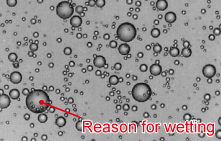 |
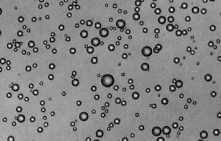
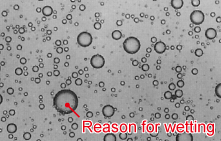
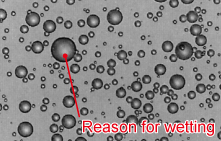
Dry Fog that AKIMist® "E" produces is an ultra-fine fog with a uniform, mean droplet diameter of 10 μm or less.
Powerful, high-efficiency
One unit of AKIMist® "E" can produce maximum 14.4 L/hour (3.8 GPH) of Dry Fog at air pressure 0.5 MPa (73 psi).
Features of AKIMist® "E" Dry Fog Humidification System
Ultra-fine and uniform fog droplets
| AKIMist”E” |
Conventional pneumatic |
|
|
|
|
| Spinning disk type |
Ultrasonic type |
|
|
|
Dry Fog that AKIMist® "E" produces is an ultra-fine fog with a uniform, mean droplet diameter of 10 μm or less.
Powerful, high-efficiency
One unit of AKIMist® "E" can produce maximum 14.4 L/hour (3.8 GPH) of Dry Fog at air pressure 0.5 MPa (73 psi).
Energy-saving humidification system
Compared with steam humidification systems, direct spray humidification that lowers room temperature by 2 degrees C helps reduce cooling load on air-conditioners and CO2 emission.
Installation Examples


Why Is Dry Fog Non-Wetting?
Dry Fog that AKIMist® "E" produces is an ultra-fine fog with a mean droplet diameter of 10 μm or less, which doesn't wet the objects it touches.
Small droplets rebound from an object, but large droplets burst and wet the object. Dry Fog droplets are so fine that they do not burst or wet the objects it touches.


