
News & Notices
- HOME
- News & Notices
- Dust Control Without Soaking: How Fine Fog Captures Airborne Dust | Newsletter Vol. 35
Dust Control Without Soaking: How Fine Fog Captures Airborne Dust | Newsletter Vol. 35
Have you ever noticed how the air can feel cleaner after rain?
That’s because falling droplets can capture tiny dust particles in the air and bring them down to the ground. But in an industrial site, creating “rain” through water sprinkling is not exactly ideal. Floors can get muddy. Equipment can get wet. Cleanup becomes another job.
Use large dust collectors, and you may need space, ducts, power, and a budget that is not always available.
Fine fog takes a different approach.
Instead of flooding surfaces, IKEUCHI’s nozzle-based systems generate fine droplets that stay suspended in the air long enough to collide with airborne dust particles.
When dust particles collide with the mist, they become heavier and settle—helping control dust without soaking the surrounding area.
How Fine Fog Captures Airborne Dust
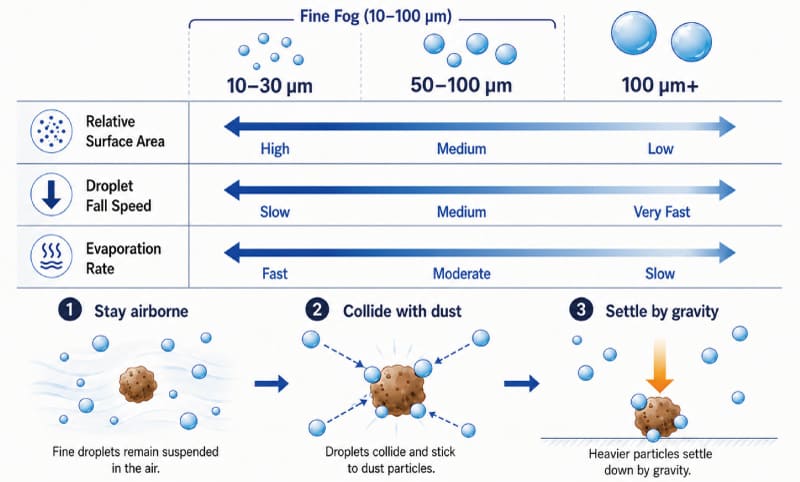
Fine droplets are better suited for dust suppression because they remain airborne longer and can interact with dust before it spreads.
Larger droplets fall more quickly and may bypass fine airborne dust, reducing capture efficiency.
Related article: Learn more about Classification of Spray Droplet Size
Here are three examples from actual industrial sites.
#1. Coal storage dust suppression with ultra-fine fog
At a chemical plant’s coal storage area, airborne dust was causing concerns around the site.
IKEUCHI proposed a fine fog system that helps keep the area humid enough to suppress dust effectively—without creating mud or requiring large-scale infrastructure.
▶ Read: Airborne Dust Control at a Coal Storage Site Using Ultra-Fine Fog Nozzles
#2. Blast furnace taphole dust suppression with high-velocity fog
A few minutes of taphole drilling can quickly send dust rising through a steel plant.
How can high-velocity fog help prevent dust from spreading—even in hot, high-updraft environments?
▶ Read: Blast Furnace Taphole Dust Control with High-Velocity Fog in Steel Plants
#3. Airborne sand dust reduction during casting
In a casting process, airborne sand dust was affecting the work environment.
By applying fine mist around the dust source, the plant reduced airborne sand dust by 20%.
▶ Read: Fine Mist Cuts Casting Sand Dust in Automotive Foundries
✨ Same mist, completely different scene.
Fine mist is not just for solving industrial challenges. The same technology is also being used at VIE presents ZEN NIGHT KYOTO, a special night viewing event at Tofukuji Temple in Kyoto.
At the event, IKEUCHI’s mist system generates a “Sea of Clouds,” helping create a serene and enchanting atmosphere on the grounds of a historic Zen temple—as part of an immersive experience of sound, silence, light, shadow, and mist.
Want a quick glimpse of the event? 🎥

|

|