
News & Notices
- HOME
- News & Notices
- The Hidden Value of Moisture Control in Cotton Spinning | Newsletter Vol. 40
The Hidden Value of Moisture Control in Cotton Spinning | Newsletter Vol. 40
Can something invisible affect both the quality and weight of a product? For cotton yarn, the answer is yes: moisture.
|
Cotton naturally absorbs moisture from the surrounding air, and its moisture content affects yarn strength, weight, and performance in subsequent manufacturing processes. In the spinning industry, yarn is conditioned to an appropriate moisture level to maintain quality and reduce the risk of breakage. |

|
Because cotton yarn is generally sold by weight, proper moisture conditioning also matters commercially. Industry standards specify how moisture is accounted for when determining yarn weight.
The challenge is to distribute moisture evenly throughout a tightly wound yarn cone—not just on its surface.
In one Indonesian spinning mill, IKEUCHI’s Dry Fog humidification system helped raise the moisture content of yarn cones from 6.0% to 7.5%—increasing the weight of each cone from 2,500 g to 2,530 g.
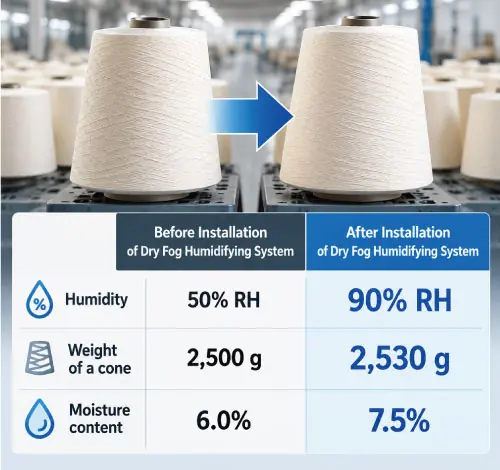
But how did each yarn cone gain 30 g in weight—without wetting the floor or surrounding equipment?
See how Dry Fog achieved uniform moisture conditioning—even deep inside the yarn cones.
▶ Read: Uniformly Moistening Deep inside the Yarn Cone
At another spinning mill in 2023, Dry Fog increased yarn cone weights by an average of 2.64–2.80%—even for cones stacked toward the center. The mill also reported approximately US$7,800 in additional monthly sales revenue from the increased yarn weight.
Why Doesn’t Dry Fog Wet Surfaces?
The secret lies not only in the small droplets, but also in the absence of large ones. Dry Fog has a mean droplet diameter of 10 μm or less, with no droplets larger than 50 μm. Other humidifiers may have similarly small mean droplet diameters but still produce larger droplets that settle on surfaces and cause wetting.
These ultra-fine, uniform droplets evaporate rapidly in the air. At the Indonesian spinning mill, Dry Fog enabled uniform moisture conditioning throughout the yarn cones without wetting the floor or surrounding equipment.
👉 Learn more about Dry Fog and its non-wetting properties
Want to see just how “dry” this fog really is? Watch the Dry Fog Demonstration:

👉 Product Information: Dry Fog Humidifier AKIMist “E”
Explore More Textile Humidification Applications
From spinning and weaving to other textile manufacturing processes, proper humidity control can help improve product quality, reduce production interruptions, and maintain stable operations.
Discover how Dry Fog humidification is being used in different textile applications:
👉 Explore More Textile Humidification Case Studies
For more information about our humidification technology and systems, visit IKEUCHI’s Industrial Humidification Solutions.
Related Technical Article
Want to know more about how humidity control affects textile quality and production efficiency?
▶ Read: Reducing Defects and Improving Efficiency in Textile Manufacturing: Dry Fog Humidification