
Keeping Fabrics Clean and Smooth: How Dry Fog Humidification Solves Static and Dust Issues in Textile Manufacturing

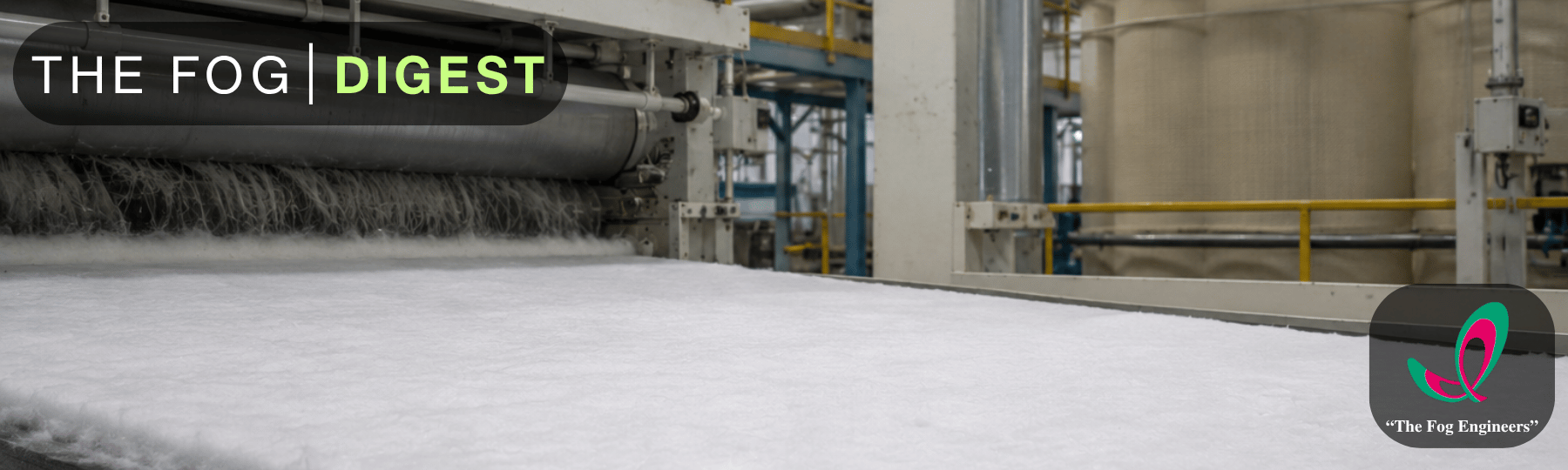
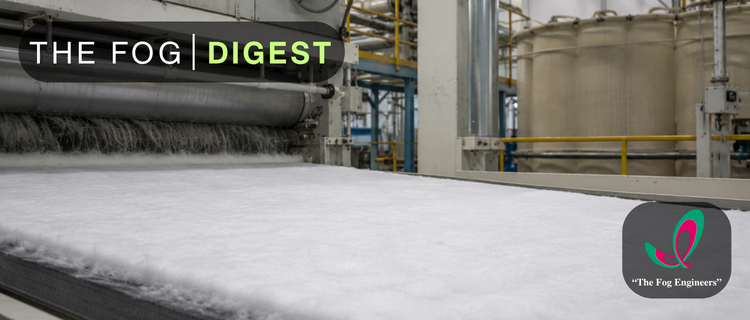
Most conversations about nonwoven quality center on the bonding stage: thermal calendering, needlepunching, hydroentangling, or chemical binders. But by the time a web reaches the bonder, its fate is largely sealed. Basis weight variation, thin spots, and density streaks are not created at the bonder. They are created upstream, in the seconds when opened fiber is airborne between the card or forming head and the collecting belt.
That window, often just a few feet of travel and a fraction of a second, is where uniformity is won or lost. One of the most overlooked variables in that window is static charge.
Fiber opening is an aggressive mechanical process. Whether fibers pass through a licker-in roller ahead of a card or get stripped off a disperser roll in an airlaid system, they experience friction, separation, and rapid acceleration. That mechanical action generates triboelectric charge on the fiber surface, particularly with synthetic fibers like polypropylene and polyester that hold a charge rather than dissipating it.
In a sufficiently humid environment, that charge bleeds off quickly through a thin surface film of moisture. In a dry environment, it does not. Charged fibers behave unpredictably in the air stream: they repel each other instead of dispersing evenly, they cling to duct walls and rollers instead of following the intended air path, and they clump instead of laying down as discrete, randomly oriented fibers.
The result is a web that looks fine from a distance but is inconsistent up close, with localized density variation that shows up later as weak points, inconsistent absorbency, or uneven bond strength depending on the end application.
Because this happens before bonding, the cost is not always obvious at the point of failure. A roll that tests within basis weight spec on average can still fail a customer’s local density requirement. A filtration media producer may see inconsistent pressure drop across a roll. A hygiene product manufacturer may see absorbency variation between what looks like identical units. In each case, the root cause traces back to how evenly fiber was dispersed and deposited in the forming zone, not to anything that happened at the bonder.
Because the defect is embedded in the web structure itself, it is also expensive to catch. Basis weight scanners can flag average deviation, but they do not always catch the localized clumping that static-driven fiber flight creates. By the time a customer complaint or a failed quality check surfaces the problem, a full production run may already be affected.
Plants troubleshooting web uniformity issues tend to look first at mechanical variables: roller speed, air flow balance, fiber opening settings. These matter, and they are usually the first things adjusted. But if ambient relative humidity in the forming room is low, especially during winter months or in facilities with strong makeup air exchange, mechanical adjustments alone will not fully resolve the problem. The charge keeps regenerating faster than any single mechanical fix can compensate for.
Relative humidity in the forming area determines how quickly triboelectric charge dissipates once it builds. Keep the air within a stable, moderate humidity band and fibers hold less charge to begin with, and what charge does build dissipates faster. Let the air run dry and the problem becomes self-reinforcing: charged fibers cling to charged equipment surfaces, which increases friction, which generates more charge.
This is where AKIMist®E Dry Fog humidification becomes relevant to the forming room specifically, rather than the plant floor broadly. AKIMist®E uses two-fluid nozzle technology to produce a true Dry Fog: droplets small enough to flash-evaporate into the air rather than settle as surface moisture. That distinction matters in a fiber opening and web forming environment, where any wetting of fiber, ducting, or forming belts would introduce a different set of problems entirely.
Because the fog stays airborne and evaporates rather than wetting surfaces, AKIMist®E can raise and stabilize relative humidity in the forming zone without depositing moisture on fiber, screens, or conveyor belts. That keeps static dissipation working in the background, continuously, rather than relying on periodic anti-static treatments or reactive troubleshooting when a run starts producing thin spots. For nonwoven producers running technical textiles or filtration media where basis weight consistency is a specified requirement, that kind of steady, non-wetting humidity control in the forming room is often the missing piece between mechanical tuning and consistent output.
Web uniformity problems that show up at the bonder or in final QC often start much earlier, in the brief airborne moment when fiber is opened and dispersed. Static charge from low humidity is a quiet contributor to that inconsistency, and it is one that is easy to overlook because its effects surface downstream rather than at the source. If your forming room runs dry, especially seasonally, it is worth asking whether humidity, not just mechanical setup, is the variable holding back your web consistency.
If you would like to talk through how Dry Fog humidification could fit into your nonwoven forming process, reach out to The Fog Engineers. We would be glad to help you think it through.