
News & Notices
- HOME
- News & Notices
- Industrial Heat Protection with Fine Mist Cooling for Workers, Equipment, and Process Air | Newsletter Vol. 36
Industrial Heat Protection with Fine Mist Cooling for Workers, Equipment, and Process Air | Newsletter Vol. 36

Can your facility handle scorching summer heat?
Japan’s summer heat has become so extreme that days reaching 40°C (104°F) or higher now have an official name: kokushobi, often translated as “brutally hot days.”
And Japan is far from alone. Recent heatwaves across Europe are another reminder that extreme summer heat is becoming a global challenge—for cities, workplaces, and industrial operations alike.
As this article shows, Japan has been stepping up efforts to protect people from dangerous heat. Our Outdoor mist cooling systems have also been used for years at sports venues, public facilities, shopping areas, and train stations.
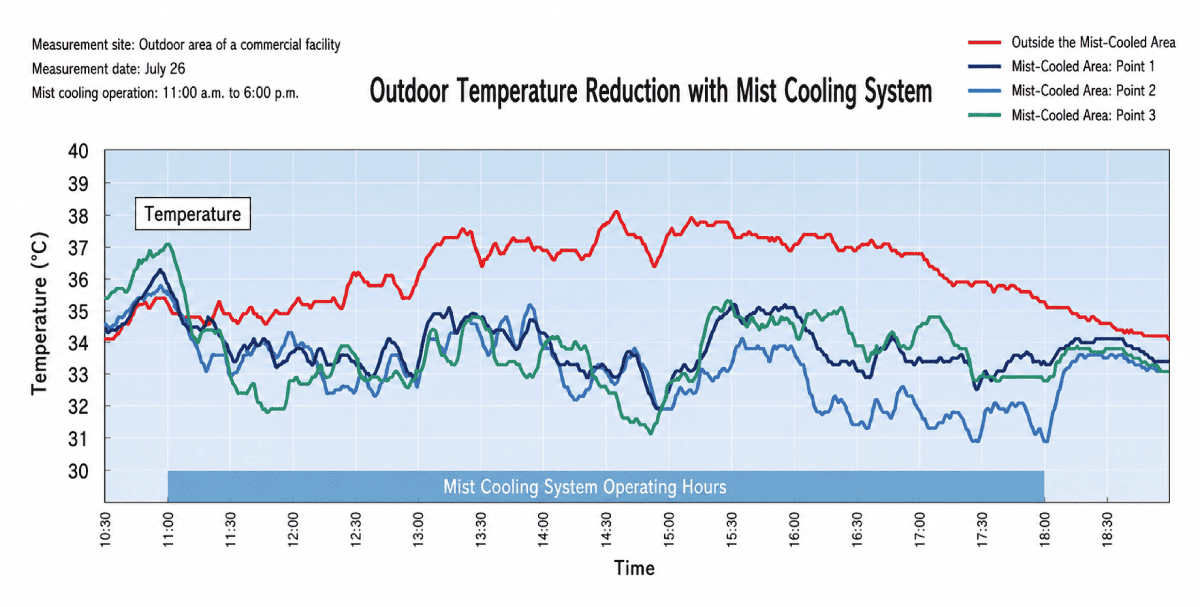
At one outdoor installation, temperatures in the mist-cooled area were approximately 3–5°C lower than in the surrounding area during operation, helping reduce heat stress—without giving passersby an unwanted shower.
Extreme heat does not stop at city streets. At industrial sites, it can threaten workers, disrupt equipment, and affect process stability.
Protect Workers from Heat
Case #1: Heat Protection at a Propane Refill Station
At an outdoor propane refill station, conventional cooling equipment could not be used in the explosion-proof work area.
How could operators stay safer from extreme heat without compromising site safety?
▶ Read: Customer Interview: Preventing Heatstroke at a Propane Refill Station
Case #2: Mist Cooling Cuts Factory Heat by 3 to 5°C
At a large, open factory, ceiling fans were not enough and air conditioning was impractical.
Could fine mist cut the heat without wetting workers, floors, or equipment?
▶ Read: Fine Mist Fans for Heat Mitigation in Large Industrial Workspaces
Protect Equipment from Heat
Case #3: Fine Fog Cooling for Stable Data Center Operation
Before the next heatwave hits, is your data center ready?
At one data center, extreme heat pushed more than 200 rooftop A/C units to their limits, reducing efficiency and increasing the risk of short circuits and thermal trips.
See how a simple fine fog retrofit supported more stable operation and reduced the cooling load—without major modifications.
▶ Read: Cooling Data Centers with Fine Fog for Stable Summer Operations
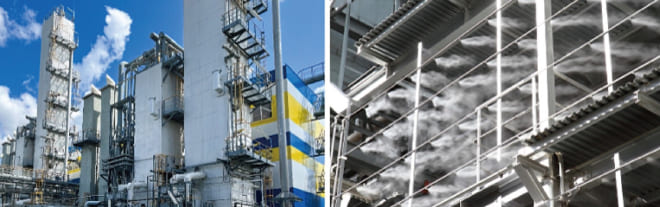
Case #4: Compressor Inlet-Air Cooling at a Petrochemical Plant
Hot summer air is less dense, reducing the mass of air drawn into large compressors and potentially affecting process stability.
Could fine fog cooling help maintain more stable summer operation?
▶ Click on the image below to read the full case study
Case #5: Compressor Room Heat Control
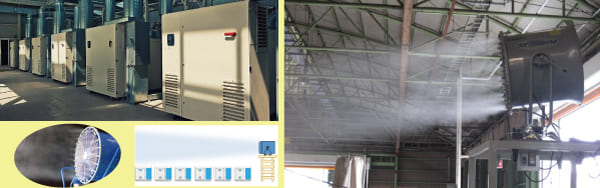
Critical compressors faced heat-related shutdowns, but direct misting was out of the question.
How could the room be cooled without wetting the equipment?
▶ Click on the image below to read the full case study
Protect Biological Treatment from Excess Heat
Case #6: Cooling Blower Air for Biological Wastewater Treatment
In paper, food, and chemical plants, biological wastewater treatment depends on healthy microbial activity. But excessively hot blower air can raise aeration tank temperatures and disrupt the process.
Could fine mist cool the blower air before it reaches the tank?
▶ Read: Cooling of Blower Air with Fine Mist for Aeration Tanks
Protect Livestock from Heat Stress
People and equipment are not the only ones feeling the heat.
A new press release from IKEUCHI Europe highlights our Semi-Dry Fog livestock cooling technology, developed through years of experience in Japan’s hot and humid climate.
Which part of your operation is feeling the heat—people, equipment, or process air?
Reply with a few details. The Fog Engineers will help you assess whether mist cooling is a practical fit.