
Articles by Industry: Agriculture | Benefits of Dry Fog in CEA | Greenhouse Humidity Management | Advanced Humidification for Indoor Farming | Optimize Crop Yield | Sustainable Farming



Tipburn appears as necrotic margins on new lettuce leaves and remains one of the most common quality defects in indoor and greenhouse production. Though often misdiagnosed as calcium deficiency, this issue typically stems from poor movement of calcium within the plant, not a lack in the nutrient solution.
At the same time, consumers reject tipburned heads even in small doses, leading to yield loss and reputational damage.
A key study showed that when relative humidity (RH) during dark periods was reduced from 95 % to 90 %, calcium concentration in leaves increased and tipburn delayed. Further lowering RH below 90 % had little effect, simply avoiding nighttime saturation was enough to make a measurable difference.
High daytime RH above 70 % slows transpiration, blocking calcium uptake even when soil solution is adequate.
Fast growth rates under high light (above 300 µmol·m⁻²·s⁻¹) increase calcium demand faster than plants can supply it. In stacked-layer systems, tight canopies and low airflow exacerbate this, leaf boundary layers restrict gas and moisture exchange.
Typical interventions include foliar calcium sprays and increased airflow, but these are insufficient on their own. A greenhouse trial combining irrigation, fogging, and foliar calcium applications showed no significant reduction in tipburn unless humidity and transpiration patterns were optimized.
A plant factory study intentionally lowering RH during dark periods while keeping it stable avoided tipburn and improved nutrient uptake.
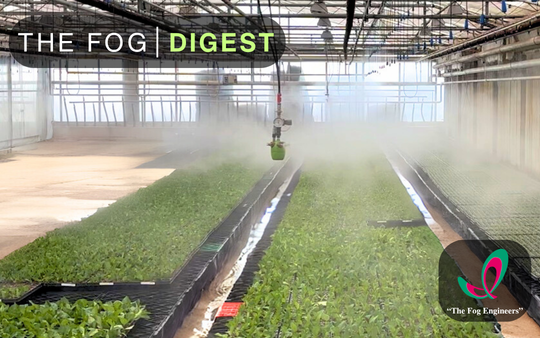
That is why ultra-fine Dry Fog humidification is uniquely suited to this challenge:
Tipburn is not random. It follows predictable environmental patterns linked to humidity, temperature, light, and airflow. By managing RH during the night, not just during the day, you enable the plant’s own vascular system to deliver essential calcium to rapidly growing tissues.
Precision humidification is not just a comfort feature; it is a tool for plant physiology. Indoor growers who control microclimates intelligently reduce waste, protect quality, and move next-generation cultivation from guesswork to performance science.

Articles by Industry: Agriculture | Benefits of Dry Fog in CEA | Greenhouse Humidity Management | Advanced Humidification for Indoor Farming | Optimize Crop Yield | Sustainable Farming

Dry Fog For Cannabis Cultivation | How to Grow Quality Bud | Indoor Grow for Cannabis
Humidity: The Hidden Ingredient for Healthier Crops & Higher Yields