Articles by Industry: Agriculture | Benefits of Dry Fog in CEA | Greenhouse Humidity Management | Advanced Humidification for Indoor Farming | Optimize Crop Yield | Sustainable Farming

In indoor cultivation, the concept of “perfect conditions” often centers on light intensity, nutrient balance, and temperature control. Yet even the most advanced grow environments can fall short of their potential when one essential factor drifts out of range: humidity.
Humidity, and by extension the vapor pressure deficit (VPD), influences nearly every aspect of plant health. It affects transpiration, nutrient uptake, CO₂ exchange, and growth rate. Inconsistent or uncontrolled humidity can lead to uneven growth, slower development, and increased disease pressure, even in otherwise optimized facilities.
Maintaining ideal humidity is more complex than setting a target percentage. Plants are living systems that continuously release moisture through transpiration, altering the humidity of their environment minute by minute. As lighting schedules change, irrigation occurs, or HVAC systems cycle on and off, humidity levels fluctuate rapidly.
These shifts create pockets of microclimates within the same room. In one corner, humidity may spike to a level that encourages mildew growth, while another zone may become too dry, causing stomata to close and photosynthesis to slow. Balancing these conditions consistently across multiple zones is one of the most persistent challenges for growers.
When air becomes too dry, the difference between the moisture inside the leaf and the surrounding air widens. This difference drives transpiration, and excessive loss of water vapor forces the plant to close its stomata to prevent dehydration. Once closed, the plant also reduces CO₂ intake, limiting photosynthesis and energy production.
Conversely, when humidity is too high, plants struggle to release water vapor effectively. This slows nutrient transport and can leave tissues waterlogged. High humidity also increases the likelihood of fungal growth and pathogen spread, particularly in densely packed canopies.
The ideal range of relative humidity varies depending on crop species and growth stage, but most controlled environment agriculture (CEA) specialists monitor VPD rather than humidity alone. VPD measures the difference between the moisture in the air and the leaf’s internal moisture, providing a clearer indication of plant stress or comfort.
Many facilities rely on conventional humidifiers or misting fans to introduce moisture into the air. While these systems are effective in some settings, they often struggle to maintain uniform humidity throughout large grow spaces. Larger droplets tend to settle on leaves, equipment, or floors before they evaporate, resulting in uneven conditions and increased risk of wet surfaces where pathogens can thrive.
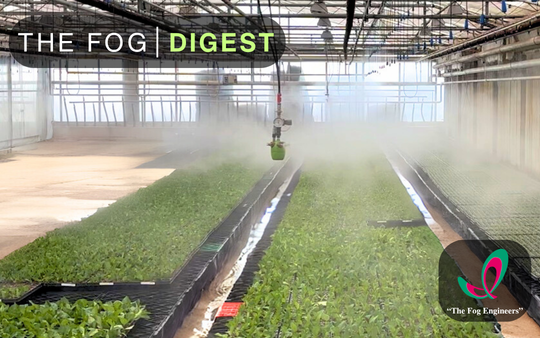
Dry fog technology takes a different approach. It uses precision-engineered nozzles to produce extremely fine droplets—typically around 7.5 microns in diameter—that remain suspended in the air until they fully evaporate. This allows the system to increase humidity evenly without wetting plants or surfaces.
Because of this property, dry fog systems are well-suited for controlling humidity in sensitive indoor grow environments. They can respond quickly to changes in temperature or plant transpiration, maintaining a more stable VPD that supports optimal plant function.
IKEUCHI’s AKIMist®E dry fog humidifier has been applied in a wide range of controlled environment facilities, including cannabis, leafy greens, and propagation systems. The system generates dry fog using compressed air and water, without producing excess heat or large water droplets. Each nozzle can cover a significant area while consuming relatively low water and air volumes, making it energy efficient compared to traditional humidification equipment.
Growers who use this type of system often do so not only to maintain ideal humidity, but also to reduce the environmental variability that leads to inconsistent growth. By improving humidity uniformity, plants are able to sustain steady transpiration and nutrient uptake, supporting more predictable development and yields.
As indoor cultivation scales and competition increases, growers are looking beyond lighting and irrigation technologies to optimize the full growing environment. Humidity control is no longer a background parameter—it is a critical variable that influences every stage of production.
Facilities that can maintain consistent humidity and VPD tend to experience fewer disease outbreaks, lower plant stress, and better crop uniformity. For high-value crops such as cannabis, where small differences in quality or yield have a measurable financial impact, precise humidity control can directly affect profitability.
The next phase of innovation in controlled environment agriculture will depend on how effectively growers manage invisible environmental variables. Temperature, CO₂, and humidity do not act independently, and systems that can maintain balance across all three will define the standard of “perfect conditions” going forward.
As technology continues to evolve, the tools for achieving these balanced environments are becoming more accessible. For many growers, adopting dry fog systems like the AKIMist®E represents a practical step toward achieving truly consistent conditions—conditions that allow plants to perform at their best, every day of the growth cycle.

Articles by Industry: Agriculture | Benefits of Dry Fog in CEA | Greenhouse Humidity Management | Advanced Humidification for Indoor Farming | Optimize Crop Yield | Sustainable Farming
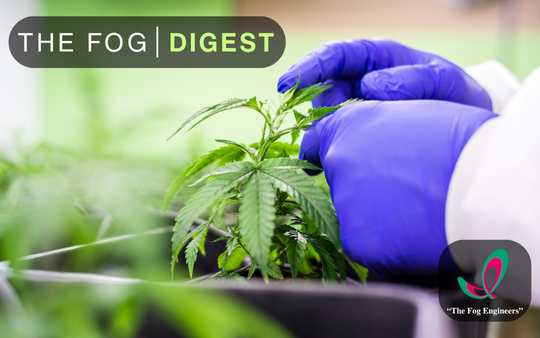
Dry Fog For Cannabis Cultivation | How to Grow Quality Bud | Indoor Grow for Cannabis
Humidity: The Hidden Ingredient for Healthier Crops & Higher Yields