Dry Fog For Cannabis Cultivation | How to Grow Quality Bud | Indoor Grow for Cannabis

When we think about plant care, humidity is often mentioned. But it is easy to overlook just how much effort your plants are putting in behind the scenes to manage their environment. In controlled environments, what we see on the surface is only part of the story.
Plants do not just grow—they constantly regulate themselves. When the air is too dry, they increase transpiration to cool themselves and maintain nutrient transport. This process is essentially the plant “sweating.” It is invisible to most growers, yet it represents stress that, if persistent, can affect growth, yield, and overall crop consistency.
Even small fluctuations in humidity can create micro-stress events for plants that are difficult to detect:
While these reactions might seem minor, their effects accumulate over time. The result can include uneven growth, slower development, and inconsistencies between batches. This is especially true in high-density grow rooms where airflow and canopy coverage vary from one section to another.
In many cases, environmental stress is only noticed after it has already affected the crop. By the time visible signs appear, some of the lost yield or quality cannot be recovered. Preventing stress before it happens is much more effective than trying to fix it after the fact.
A common approach to combat dry air is to increase overall humidity in the grow room. However, not all methods achieve the desired effect. Conventional misting systems or sprinklers can create new problems:
These approaches may feel like they are helping, but they can introduce new stress factors for the plants and for your operation.
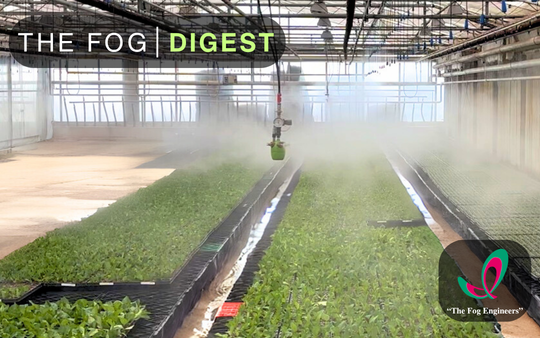
Dry fog humidification addresses the problem differently. By producing ultra-fine droplets that evaporate almost immediately, dry fog increases humidity without wetting surfaces. This allows growers to:
Because the droplets are so fine, they behave more like a vapor than a mist, distributing evenly and reaching even the most crowded parts of a canopy. This method creates an environment where plants can focus their energy on growth instead of survival.
Many growers notice that when dry fog is properly integrated, their plants show improved uniformity, faster development, and reduced susceptibility to stress-related issues.
Even in a well-designed grow room, microclimates naturally develop due to variations in airflow, lighting, and canopy density. Without precise humidity control, these pockets can become hotspots for stress:
Dry fog allows for more consistent conditions across the entire space. It integrates with existing airflow to smooth out these differences and provide a more uniform environment, helping every plant experience optimal conditions.
As cultivation technology advances and growers aim for higher consistency and yield, environmental control becomes a differentiator. It is no longer enough to simply maintain basic humidity ranges. Plants are more sensitive to fluctuations than most realize, and even small variations can impact the results.
Investing in precision environmental control, such as dry fog humidification, ensures that your grow room supports the advanced genetics and high-density systems used today. Plants spend less energy compensating for environmental stress and more energy developing stronger, healthier growth.
Stable humidity is not just a comfort measure. It is a critical factor for reducing stress, optimizing growth, and ensuring consistent crop quality.