Automating Basin Wall Cleaning at a Wastewater Plant with Rectangular-Spray Nozzles



Solutions or Products Featured
in This Case Study
Using a spray nozzle with a wide adjustable flow range enabled stronger spray impact and effective degreasing without adding more nozzles.
One day, an engineering company contracted to build a paint facility at a specialty vehicle plant approached IKEUCHI for a solution.
Specialty vehicles—such as dump trucks and tank trucks—are purpose-built for specific applications. Compared with standard vehicles, they vary widely in shape and size, presenting unique challenges in the painting process.
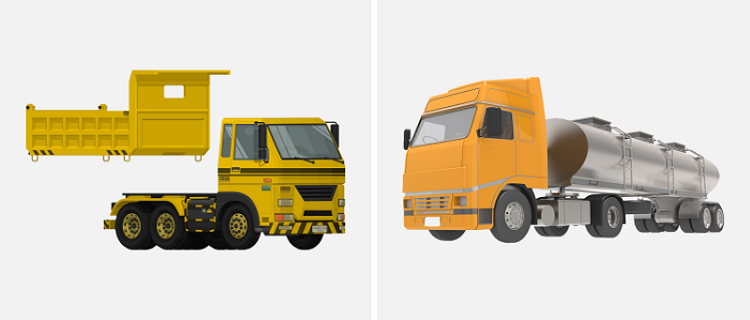
Examples of specialty vehicles
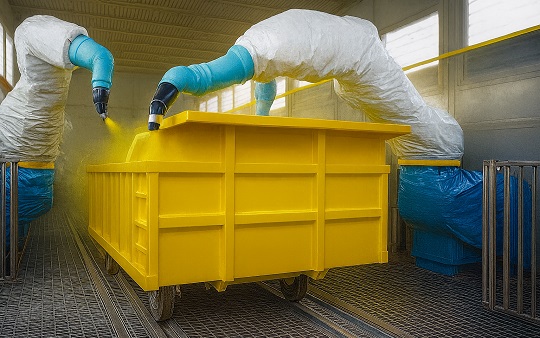
Top coating
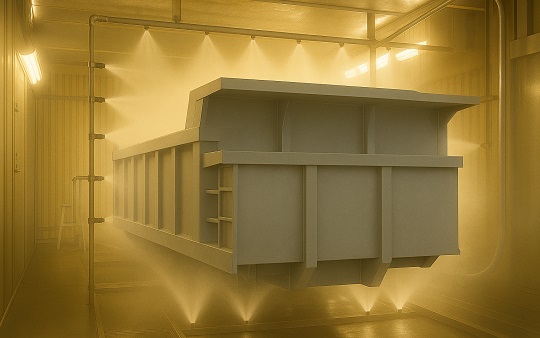
This case concerned nozzles used in the pretreatment process prior to painting. Pretreatment is a critical sequence of steps—beginning with hot water rinsing, followed by alkaline degreasing and rinsing, and culminating in electrodeposition—that largely determines the quality of subsequent primer surfacer and topcoat layers. Among these steps, alkaline degreasing plays a vital role in removing oil, dust, and other contaminants from the workpiece surface, thereby improving paint adhesion.
The pretreatment line was originally designed to use full cone nozzles. Testing, however, revealed that spray impact was too weak, leaving areas where the alkaline solution could not sufficiently reach. As a result, the risk of inadequate degreasing—and eventual paint peeling—became evident.
To expand coverage, increasing the number of nozzles would have been the obvious solution, which required raising the pump discharge volume. However, the pump specified under the current design had already been procured, making any change to the system configuration impossible.
Moreover, because specialty vehicles vary widely in size and shape, the end user requested nozzles with a broad adjustable flow range. Confronted with these constraints, the customer could not identify a viable solution.
Neither increasing the number of nozzles nor increasing the flow rate was an option. Yet stronger spray impact was required—along with broad flow adjustability. Although the challenge seemed daunting, our Fog Engineer quickly identified a solution and eased the customer’s concerns.
The proposal was to replace the conventional full cone nozzles with the DDRP Series spray nozzles, producing a flat spray pattern—115° wide and 60° thick—while maintaining the same flow rate.
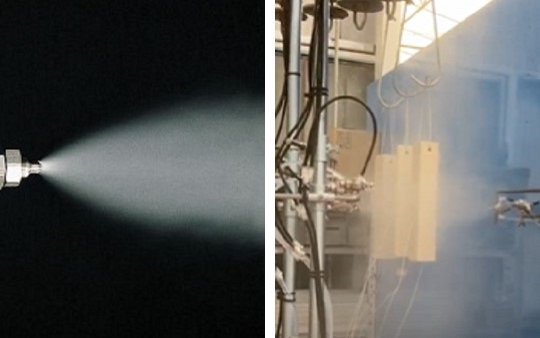
Whereas conventional full cone nozzles produce a round spray area with a 75° spray angle, the DDRP Series delivers an elongated rectangular impact zone, achieving greater spray impact at the same flow rate. In addition, with a mean droplet diameter of 460 μm—less than three-quarters that of the full cone nozzle—the DDRP generates a denser alkaline spray, enabling more efficient degreasing.
Moreover, by varying spray pressure, the DDRP allows flow rates to be adjusted up to threefold, providing the flexibility to accommodate the diverse sizes and shapes of specialty vehicle bodies.
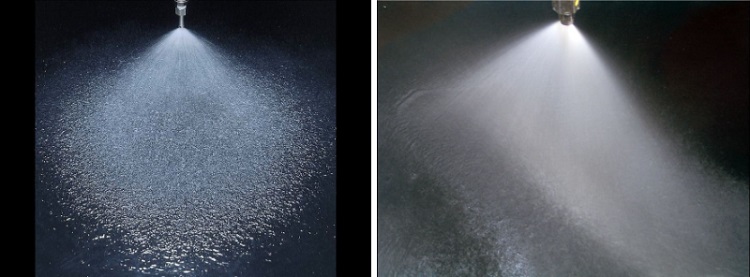
Left: Full Cone Spray Nozzle — Flow rate 27 L/min, spray angle 75°, round spray area, mean droplet diameter 630 μm
Right: Ultra-Thick Even Flat Spray Nozzles DDRP Series — Flow rate 26 L/min, spray angle 115° × 60°, elongated rectangular spray area, mean droplet diameter 460 μm
Accompanying the customer to the end user’s plant, we conducted on-site trials that confirmed the elimination of inadequate degreasing caused by residual contaminants. Both the end user and the customer expressed their appreciation, and the pretreatment line, having overcome these challenges, was successfully brought into operation.
The pretreatment line continues to deliver stable processing across a wide variety of vehicle sizes and shapes.