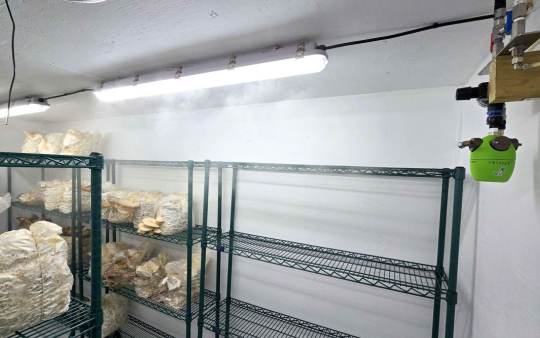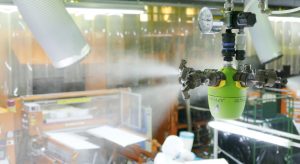
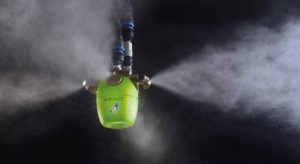

Achieving Uniform Seedling Growth with Fogging Sprayer from IKEUCHI


Solutions or Products Featured
in This Case Study
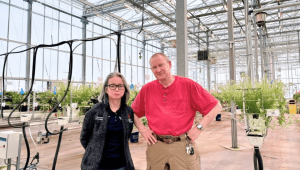
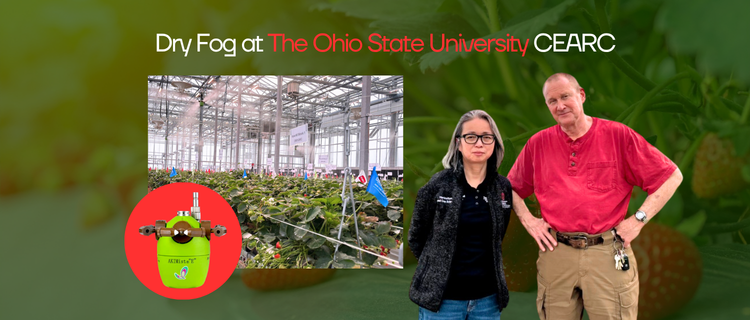
At The Ohio State University’s Controlled Environment Agriculture Research Center (CEARC), researchers are exploring new technologies to make greenhouse fruit production more productive, sustainable, and commercially viable.
Inside the facility’s strawberry greenhouse, Professor Dr. Chieri Kubota (left), Director of CEARC, and research specialist Mark Kroggel (right) are leading work focused on improving yield and fruit quality in controlled environments.
Their research greenhouse was designed to replicate real commercial growing conditions.
“Our research complex was designed to conduct studies in a setting relevant to actual commercial applications,” says Dr. Kubota. “Here in the strawberry greenhouse, we are developing technologies to produce strawberries productively and sustainably.”
One challenge quickly became clear: maintaining proper humidity in a closed greenhouse environment.
During the first year of production in the commercial-scale strawberry chamber, the team encountered several issues common to greenhouse strawberry growers.
Powdery mildew management was a concern, and researchers also discovered the presence of Neopestalotiopsis, a fungal disease recently identified in strawberry propagation systems.
One of the most significant environmental challenges was low humidity.
Data analysis showed that the greenhouse environment frequently dropped to very low relative humidity levels.
“Without a humidification system, relative humidity can drop to 20 to 30 percent,” Dr. Kubota explains. “If you know plants, you get a heart attack when you see 20 percent.”
Low humidity caused plant stress and limited photosynthesis.
“When plants are stressed, stomata close,” Kroggel explains. “When the stomata close, there is no CO₂ uptake. That ultimately limits productivity.”
Because much of the strawberry growing season occurs during non-cooling periods, the enclosed greenhouse structure combined with concrete floors made it difficult to maintain adequate humidity levels naturally.
The team needed a solution that could raise humidity without introducing canopy wetness.
Before installing Dry Fog, the greenhouse relied on a nighttime misting system that had previously been used in strawberry production to prevent a physiological disorder known as teppan, a fruit surface disorder associated with low humidity and calcium imbalance in greenhouse strawberries.
However, misting during the day was avoided.
“We don’t want to wet the canopy during daytime,” Dr. Kubota says. “So we didn’t have a good humidity control system in the greenhouse.”
Traditional misting or fogging systems can leave water droplets on plant surfaces, which creates another problem: disease risk inside the canopy.
“When water reaches the plant canopy, it can become trapped,” Kroggel explains. “Humidity inside the canopy can become much higher than the surrounding environment. That promotes foliar fungal diseases such as botrytis.”
To support plant productivity while minimizing disease pressure, the research team began looking for a humidification solution that could increase humidity without wetting plants.
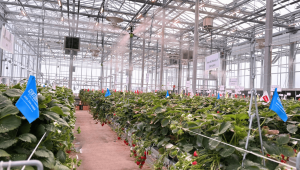
The CEARC team installed an AKIMist® Dry Fog humidification system in September 2024.
Dry Fog technology produces extremely fine droplets that evaporate almost instantly.
According to Dr. Kubota, humidification technologies can generally be categorized into three droplet classifications:
Because Dry Fog produces the smallest droplets, the surface area of the water particles is significantly larger relative to their volume. This allows the droplets to evaporate before reaching plant surfaces.
“You can see the fog coming out, but it disappears well before it hits the canopy,” Kroggel says. “I can literally put my hand in front of the fog stream and it doesn’t get wet.”
Instead of settling on leaves or fruit, the droplets quickly transition into vapor. This raises relative humidity while keeping the crop dry.
The benefit is not only for plants.
“Workers also like it,” Dr. Kubota adds. “They don’t get wet.”
After implementing Dry Fog humidification, the researchers began to notice visible differences in the strawberries themselves.
During the first year of production, fruit appearance had been inconsistent.
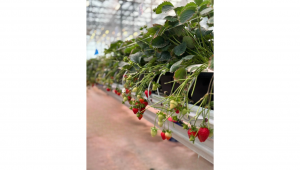
“The fruit lacked glossiness and had more of a dull sheen,” Kroggel says. “You expect strawberries to have that shine.”
With improved humidity control, the fruit developed a noticeably better appearance.
“Once we started growing with humidity enhancement, we saw the berries develop that sheen again.”
Humidity management also helps support plant productivity while avoiding additional disease pressure.
“Dry Fog allows us to promote plant productivity without promoting foliar disease,” Kroggel explains. “With other systems it can become a tradeoff. You either increase humidity and risk disease, or keep things dry and stress the plants.”
The Dry Fog system was installed by the CEARC team themselves and integrated into the greenhouse control system using Priva environmental controls.
The system is operated through a relative humidity setpoint.
“We basically turn the system on and off through Priva,” Kroggel says.
Compared with high pressure fog systems, which typically operate between 1,000 and 1,500 PSI and often require regular maintenance, the AKIMist system has proven remarkably simple to maintain.
The greenhouse uses reverse osmosis water, and after two years of operation the team reports that the system has required no maintenance.
“With high pressure systems, maintenance was constant,” Kroggel explains. “With the AKIMist system, we have had it running for two years and have not needed to do anything.”
The system’s compact design also integrates easily into the greenhouse environment.
“The footprint is very small,” he adds. “Unless you point it out, people often don’t even notice it running.”
While humidification was the primary goal, the research team discovered another benefit.
Under certain conditions, the Dry Fog system can also contribute to evaporative cooling inside the greenhouse.
“Cooling is not the primary purpose of the system,” Kroggel says, “but when conditions are right it can help reduce temperatures, which was a pleasant surprise.”
For Dr. Kubota and her team, technologies like Dry Fog are also important teaching tools.
Controlled environment agriculture requires expertise across multiple disciplines.
“You have to understand plants, engineering systems, sensors, control software, pest management, and even the business side,” Dr. Kubota says. “It is a very integrated field.”
At CEARC, students learn how crop science and technology work together to support commercial greenhouse operations.
This integration is becoming increasingly important as the industry evolves.
“The emphasis used to be mainly on quantity,” Dr. Kubota explains. “Now the focus is both yield and quality. Growers are paying much more attention to flavor, consistency, and year round production.”
Sustainability is also a major focus of CEARC research.
Dr. Kubota defines sustainability as maximizing productivity relative to resource use.
Dry Fog humidification supports this goal in several ways.
Because the droplets evaporate quickly and distribute efficiently throughout the greenhouse, water use efficiency is significantly higher than many traditional humidification systems.
“Dry fog humidification is very efficient from a water use standpoint,” Dr. Kubota says.
In high tech greenhouse production systems that rely on lighting, heating, and environmental control, improving resource efficiency is critical.
The positive experience with Dry Fog humidification has led the research team to consider implementing the system in other greenhouse chambers at CEARC.
Several compartments are designed for high wire crops such as tomatoes, cucumbers, and peppers. In those environments traditional fog systems can cause wet plant surfaces because the emitters are close to the crop canopy.
“I would rather have the AKIMist system in those chambers,” Dr. Kubota says.
The team is also considering Dry Fog for leafy greens production areas where maintaining adequate humidity remains a challenge.
For commercial strawberry growers and many other greenhouse crops, humidity management often involves a difficult balance between plant productivity and disease risk.
The CEARC research demonstrates that Dry Fog technology can help resolve that tradeoff.
“If growers are producing strawberries or other soft fruits,” Kroggel says, “humidity control is essential. Having a system that promotes productivity without increasing disease pressure makes it a worthwhile investment.”