Articles by Industry: Agriculture | Benefits of Dry Fog in CEA | Greenhouse Humidity Management | Advanced Humidification for Indoor Farming | Optimize Crop Yield | Sustainable Farming

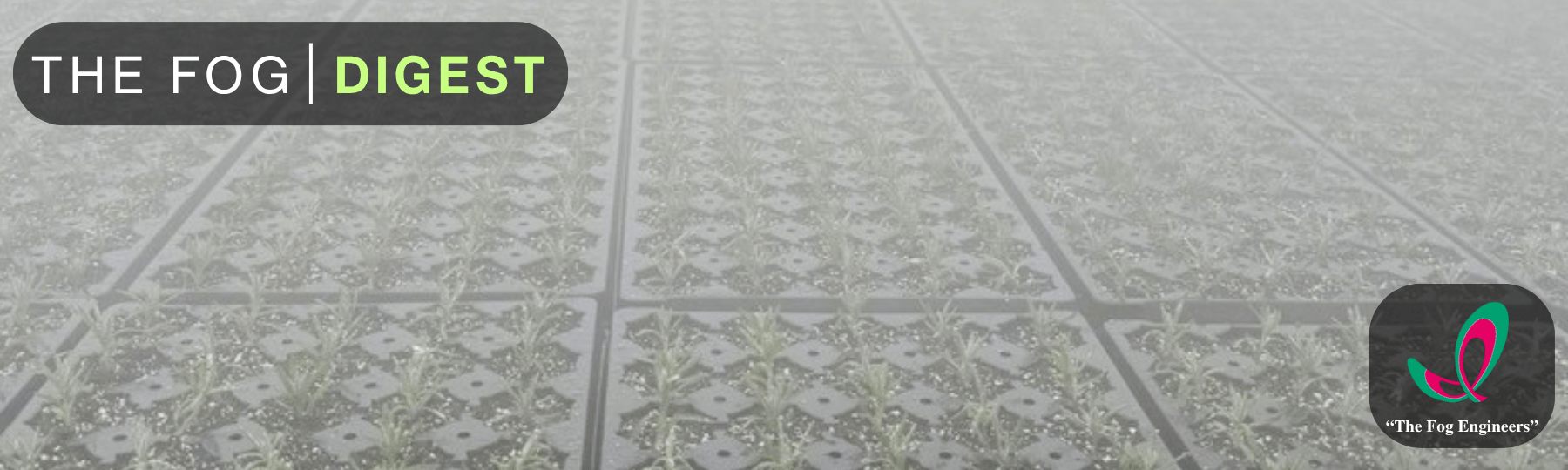
Propagation is where a crop’s entire production cycle either gets a strong start or an expensive setback. Cuttings and clones arrive in the propagation room with no root system, which means every bit of moisture they take in has to come through the leaf surface. Get the humidity wrong during this window, even for a few hours, and growers see stalled rooting, wilted cuttings, or disease outbreaks that ripple through the rest of the grow cycle. For CEA operators running commercial-scale propagation, humidity control at this stage is not a comfort setting. It is closer to life support.
A rooted plant can pull moisture from the growing medium through its roots and regulate water loss through its stomata. A fresh cutting cannot do either of those things well. Until roots form, typically over a period of one to three weeks depending on species, the cutting depends almost entirely on foliar moisture uptake and a humid microenvironment to avoid desiccation.
Most propagation protocols call for relative humidity in the range of approximately 85 to 95 percent, with leaf and air temperatures held around 72 to 78°F (22 to 26°C). That is a narrow, demanding target, and it has to be sustained continuously, not just approximated on average across a shift.
Growers typically reach for one of a few tools to hold propagation rooms in that range, and each comes with tradeoffs that plant managers eventually run into.
Overhead misting and traditional foggers produce comparatively large water droplets. Those droplets do not stay airborne long enough to evaporate before landing, so they wet the leaf surface and growing media directly. That surface moisture is exactly the kind of environment that favors damping off, botrytis, and other fungal pathogens, which are already a leading cause of loss in propagation. Standing water in trays and domes compounds the problem.
Humidity domes and enclosed propagation trays trap moisture effectively, but they also trap stagnant air. Without airflow, condensation builds on the underside of the dome and drips back onto cuttings, and the lack of air exchange can create the same disease-favorable conditions growers are trying to avoid.
Whole-room HVAC humidification, meanwhile, struggles with precision at this scale. Propagation zones often need meaningfully higher humidity than the rest of a facility, and central systems are rarely built to hold a tight, elevated setpoint in just one zone without oversaturating adjacent spaces or requiring constant manual adjustment.
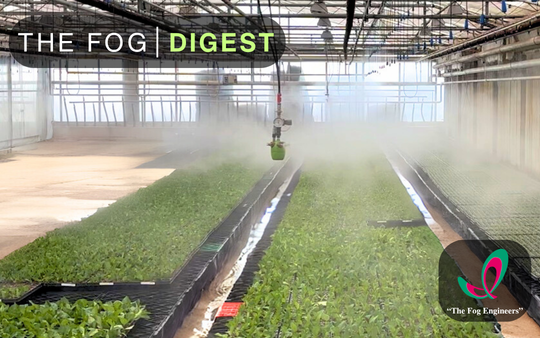
This is the gap that Dry Fog humidification is built to close. The AKIMist®E system uses a two-fluid nozzle design, air and water, engineered by Ikeuchi’s nozzle designers to atomize water into a fog with an average droplet size in the range of 7.5 microns. Droplets that small stay suspended in the air and evaporate before they ever settle on a leaf surface or growing medium.
That distinction matters directly for propagation. Because the fog adds moisture to the air rather than depositing it on the plant, growers can hold the room at the elevated relative humidity a cutting needs without creating the surface wetness that invites fungal pressure. AKIMist®E adds humidity to the environment; it is not designed to remove it, and rooms already running high humidity should be managed with that in mind.
The system integrates with a humidity controller, so the propagation zone can be held at a set target, for example around 90 percent RH, with the system cycling automatically to maintain it rather than requiring staff to check and adjust conditions throughout the day. For CEA operations running propagation as a distinct zone within a larger facility, that kind of targeted, localized control is often the difference between an environment that supports rooting and one that just gets close.
Propagation humidity problems are frequently misdiagnosed. A grower troubleshooting inconsistent rooting rates or recurring damping off often looks first at genetics, media, or nutrient timing, when the underlying issue is that the room’s humidity, or the way that humidity is being delivered, is working against the cutting rather than for it.
Before changing propagation protocols, it is worth asking a more basic question: is the humidification method in place adding moisture to the air, or is it adding moisture to the plant. Those are not the same thing, and for a cutting with no root system yet, the difference can determine whether it survives the next two weeks.

Articles by Industry: Agriculture | Benefits of Dry Fog in CEA | Greenhouse Humidity Management | Advanced Humidification for Indoor Farming | Optimize Crop Yield | Sustainable Farming
Humidity: The Hidden Ingredient for Healthier Crops & Higher Yields

The Evolution of Climate Control in Cultivation