The Unsung Hero of Food Safety: Hygienic Air Nozzles

Walk the floor of a plastic packaging operation and the problems you deal with tend to have names: jam at the thermoformer, static on the film feed, dust on the blister cavity before the product even gets there. You fix what you can see. But some of the most consistent production headaches in plastic packaging don’t have an obvious culprit standing next to them.
Humidity, or more precisely the absence of it, has a way of showing up in your quality reports without ever showing up on your troubleshooting checklist.
Plastic materials are inherently poor conductors of electricity. When a facility’s relative humidity drops, the thin layer of moisture that normally coats every surface, including your film rolls, trays, and formed parts, disappears. With nothing to dissipate charge, static electricity accumulates rapidly.
This shows up in packaging operations in a few familiar ways. Film feeding and indexing equipment becomes erratic as static causes sheets to cling to guides and rollers rather than advancing cleanly. Formed trays or blister cavities attract airborne dust and particulate before fill, introducing contamination that no inspection step downstream can fully catch. Stacked or nested parts refuse to separate. Labels misalign. Finished product that looked clean in process arrives at quality check carrying a charge that has pulled debris onto surfaces.
Generally, static charge issues arise when humidity drops below approximately 45% RH. In many production environments, particularly those with significant HVAC-driven air exchange or located in climates with low winter dewpoints, maintaining that threshold without active humidification is not straightforward.
Foreign object contamination in plastic packaging is one of those quality issues that tends to get attributed to housekeeping, to line operators, to upstream processes. What rarely gets scrutinized is whether the production environment itself is actively pulling particulate onto product surfaces.
Electrostatically charged plastic acts as a collection surface. A cavity holding a charge at the time of fill is not a neutral container waiting to receive product. It is a surface in the process of gathering whatever is suspended in the air around it. The smaller the particle, the more effectively it responds to an electrostatic field. This is a particular concern for industries where the end use of the packaging carries cleanliness expectations, such as medical device packaging, pharmaceutical blister packs, or consumer goods where cosmetic appearance is part of the brand promise.
Tracking the true cost of contamination-driven defects and rework in this context is difficult because the contributing factor is invisible and intermittent. It gets worse on dry days and better when conditions improve, which makes it easy to attribute variance to other causes.
Static is the most visible symptom, but low humidity creates other operational friction in plastic packaging environments.
Film and foil lidding materials used in blister packaging can become brittle and prone to micro-cracking at very low humidity levels, affecting seal integrity downstream. Labeling adhesives behave differently in dry conditions. Thermoformed parts running at high cycle rates in dry air can build up charge progressively through the shift, meaning the problem worsens as the day goes on rather than staying constant.
Operators often compensate with ionizing bars or blowoff equipment targeted at specific trouble points. These tools address static after it has formed. They do not address the environmental condition that created it.
The challenge in a packaging environment is that conventional humidification approaches carry their own risks. Any moisture that reaches film rolls, open product, or forming tooling as liquid droplets creates a new problem in place of the one it was solving.
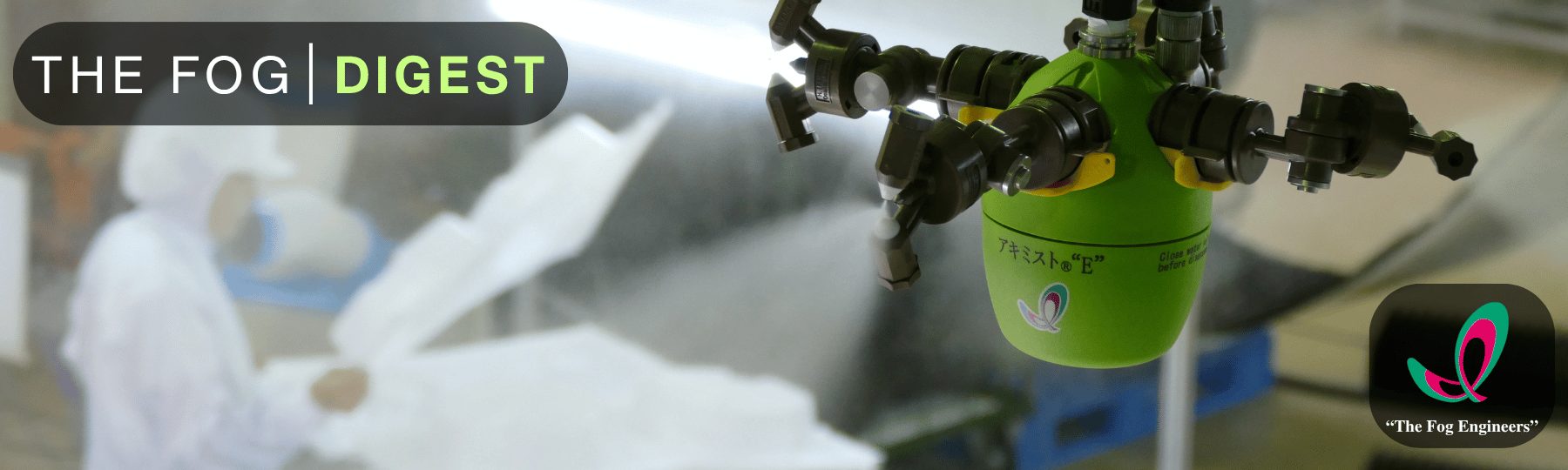
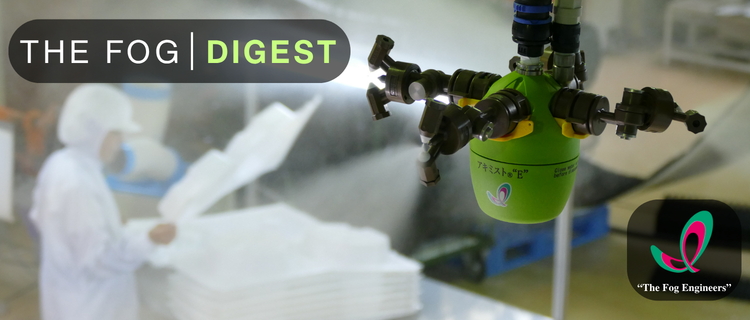
This is where Ikeuchi’s dry fog approach is designed to operate. The AKIMist®E produces droplets with a sauter mean diameter of 7.5 μm. At that scale, droplets are small enough to remain suspended in air rather than settling or wetting surfaces on contact. The system can be positioned close to specific zones within the line where static or contamination problems are concentrated, allowing targeted humidity delivery without introducing moisture risk to the product or tooling nearby.
The result is an environment held consistently above the humidity threshold where static charge accumulates aggressively, which reduces both the magnitude of charge on surfaces and the rate at which airborne particulate adheres to them.
For facilities running medical, pharmaceutical, or food-adjacent packaging where contamination documentation and quality accountability matter, consistent environmental control also supports the kind of process repeatability that audits and quality programs expect.
If your line runs cleanly some days and not others, and you have ruled out the obvious mechanical causes, it is worth asking what the relative humidity was on the days the defect rate climbed. The answer may already be in your data.