Different Humidification & Installation Methods | Types of Humidification | Premium Dry Fog


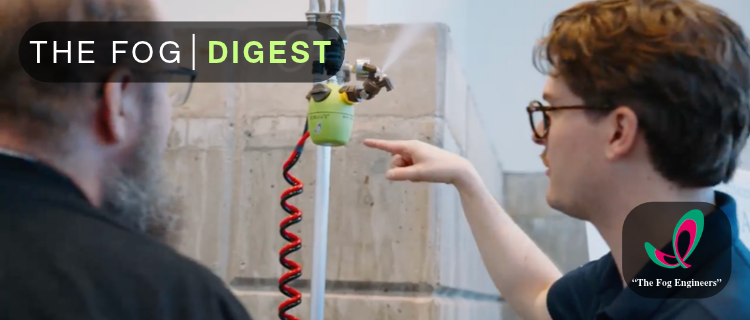
Most facilities do not go looking for a humidification system. They go looking for an explanation. Static discharge that keeps tripping sensitive equipment. Material that curls, cracks, or fails to bond the way it should. A defect rate that climbs every winter and nobody can quite say why. By the time a plant manager starts searching for a solution, the research alone can be a challenge. Terms like “fog” and “mist” get used inconsistently across the market, and it is not always clear from a product page what a system will actually do in a specific facility. That is where working with Ikeuchi’s Fog Engineers, rather than just buying a unit off a spec sheet, starts to matter.
A good starting point is rarely a product pitch. It is a conversation about symptoms. A Fog Engineer will typically ask about the specific issues showing up on the floor, whether problems follow a seasonal pattern, which lines or rooms are affected, and what has already been tried. This matters because humidity-related problems can look similar on the surface while having very different root causes. Static buildup in an electronics assembly area and static buildup in a textile mill are not solved the same way, even though both start with the same complaint. Understanding the actual process, not just the symptom, is what shapes everything that follows.
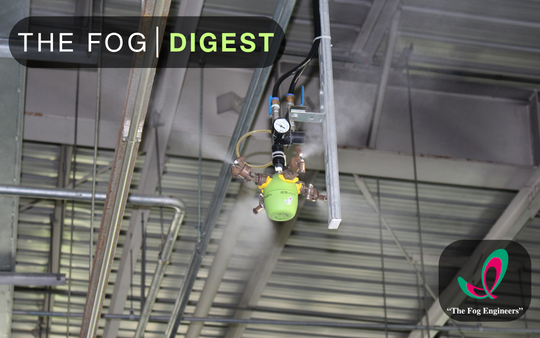
No two facilities share the same ceiling height, airflow pattern, line layout, or water quality, so a generic humidification unit dropped into a space without any of that context tends to underperform. A proper system layout accounts for where nozzles need to be placed, how airflow will move fog through the space, and how the system should respond to the specific conditions of that facility rather than a theoretical average one. This is the difference between a system that happens to run and a system that is engineered to solve the problem it was brought in for.
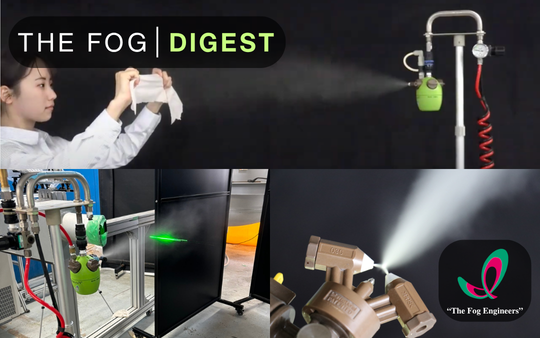
This is also where it is worth pausing on a term that can be confusing to shop around. “Fog” and “mist” are used to describe a wide range of droplet sizes, and that range matters more than it might seem. Ikeuchi pioneered Dry Fog technology, and under Ikeuchi’s own operating standard, true Dry Fog is defined by Sauter mean droplet diameter, kept at approximately 10 microns or smaller so droplets stay suspended in air and evaporate before ever reaching a surface. AKIMist®E operates at a Sauter mean droplet diameter of approximately 7.5 microns, comfortably within that range. Larger droplets are more likely to settle and cause the wetting, mineral buildup, or surface damage that a facility was trying to avoid in the first place. This comes down to how the droplets themselves behave, and understanding it can make it easier to ask the right questions when evaluating any humidification system.
AKIMist®E is built around this standard, using compressed air and water to consistently produce droplets in that dry range. Ikeuchi typically supplies the controller and sensors as part of the system, and for facilities that already have a building management or process control system in place, AKIMist®E can also be integrated into that existing setup. Either way, the system responds automatically to real-time humidity readings rather than requiring manual adjustment throughout the day, holding steady conditions even as outdoor weather or process loads shift.
Nozzle performance and longevity depend heavily on the water feeding the system. Mineral content in untreated water can affect droplet formation over time and contribute to buildup inside the system. This is why a complete solution often includes reverse osmosis (RO) water filtration rather than treating water quality as an afterthought. Supplying and sizing the RO system alongside the humidification equipment means the two are matched from the start, rather than discovered as a problem after installation.
The relationship does not end once a system is commissioned. Facilities change over time, whether that means new equipment on the floor, a shift in production volume, or simply routine maintenance needs. Ongoing support, from troubleshooting to maintenance guidance to answering questions as conditions change, is part of what separates a long-term partner from a one-time vendor.
None of this works as a checklist. The consultation, the custom layout, the water filtration, the ongoing support, all of it exists to support one outcome: a system engineered around the problem a facility actually has, not the one a generic unit assumes it has. That is what a Fog Engineer is there to build, and it is why the process looks less like a purchase and more like a partnership from the first conversation onward.
If your facility is dealing with humidity-related issues and you are not sure where to start, our team is available to talk through what you are seeing and what a properly engineered solution could look like. Reach out to Ikeuchi to begin the conversation with a Fog Engineer.