Absolute and Relative Humidity: The Relationship with Static Charge



Pharmaceutical manufacturing runs on precision. Active ingredients are measured in micrograms. Coating layers are applied in fractions of a millimeter. Particle size distributions are controlled within narrow bands that affect how a drug dissolves, absorbs, and performs. In environments built around that level of control, the air itself is part of the process.
Humidity is one of the variables that tends to get addressed last, often only after something goes wrong. But in a dry manufacturing environment, the effects of low relative humidity show up in predictable ways, and they tend to compound.
Pharmaceutical powders are composed of fine particles. Many active ingredients are milled to micron-scale sizes to improve bioavailability. Excipients like lactose, microcrystalline cellulose, and starch exist in similar particle ranges. At that scale, electrostatic charge becomes a meaningful force.
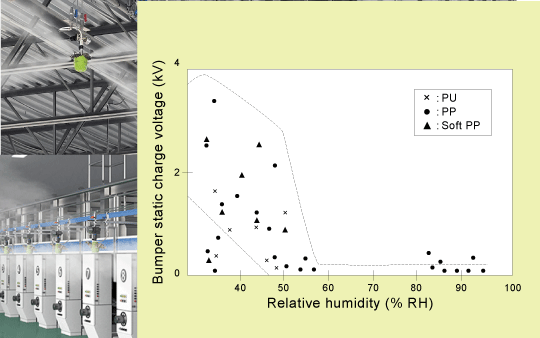
In dry air, charge dissipation slows. Surfaces that would otherwise shed accumulated charge hold onto it. When fine particles are in motion, being blended, transferred through pneumatic lines, or fed into tablet presses, they can adhere to equipment surfaces, each other, or container walls in ways that affect weight uniformity and blend consistency.
This is a predictable response to the environment. Raise the relative humidity, and charge dissipates faster. The particles move the way they are supposed to move.
Coating systems apply thin polymer films to tablet cores in rotating pan coaters that rely on carefully balanced inlet air temperature, exhaust conditions, and spray rates. When surrounding air is very dry, the coating solution can begin evaporating before it fully spreads across the tablet surface. This produces uneven film distribution, pitting, or surface roughness. The coating may also become brittle rather than flexible, increasing the likelihood of chipping during handling and packaging.
These outcomes can develop gradually as facility humidity drifts downward through seasonal shifts, often getting attributed to spray rate settings or batch variation before the environmental variable is considered.
Stable relative humidity in the coating area supports more consistent film formation. It removes one source of variability that is otherwise difficult to compensate for with equipment adjustments alone.
Fine particles that become airborne represent both a product loss and a personnel exposure concern. The conditions that cause powder to drift and adhere electrostatically are the same conditions that allow it to stay suspended in air longer.
Dry fog humidification has been used across manufacturing industries to reduce airborne particle counts. Fine water droplets interact with dust particles, increasing their effective mass and causing them to settle out of the air column more quickly. In pharmaceutical environments, this can reduce recontamination of cleaned surfaces between production runs.
The challenge with introducing moisture into a pharmaceutical space is that water is also a problem. Exposed tablet cores are moisture-sensitive. Hygroscopic powders can clump or degrade. Equipment surfaces that stay wet become contamination risks.
Dry fog, as Ikeuchi defines it, is composed of droplets with a mean diameter of 10 micrometers or less. At that size, droplets do not carry the mass to wet surfaces on contact. They remain airborne, raising relative humidity without depositing liquid onto equipment, product, or flooring.
The AKIMist®E operates on this principle, adding moisture to the air without the secondary risks that come with conventional misting or steam humidification. In environments where surface contamination is a serious concern, that distinction matters.