The Service Call That Humidity Could Have Prevented | DTG Printers

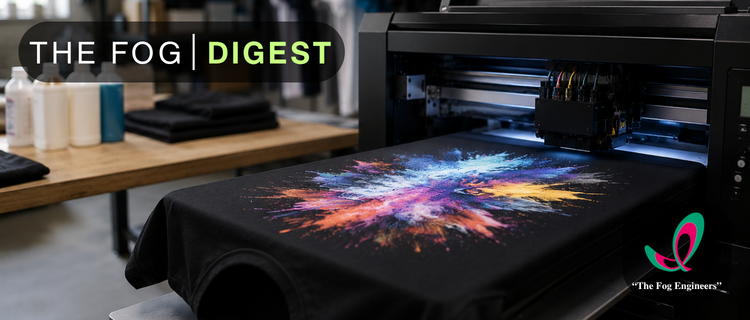
Direct-to-garment printing sits at an interesting intersection of chemistry, textiles, and production process. When a print comes out wrong — washed out, cracked, uneven — the first instinct is usually to look at the ink, the file, or the pretreatment application itself. Those are reasonable places to start. But there is a variable that sits upstream of all of them, one that is easy to overlook because it does not show up on a production report: the ambient humidity in the room where the work is happening.
DTG operators who have been at it long enough often notice that the same garment, the same file, and the same pretreatment formula can produce inconsistent results from one part of the day to another, or from one season to the next. The equipment has not changed. The process has not changed. But something has.
Pretreatment is what makes DTG work on cotton. It prepares the fiber surface to accept water-based pigment ink, and the way it dries — and how completely it dries — affects how the ink sits on the garment. Most operators know this. What gets less attention is how ambient relative humidity shapes that drying behavior before the platen ever moves.
When relative humidity in the production space is low, pretreatment can begin evaporating unevenly before it is fully pressed. The surface may appear dry while the chemistry beneath it has not fully set into the fabric. When humidity is high, pretreatment may take longer to cure, or may behave differently under heat press. The window of acceptable conditions is narrower than many assume, and it shifts depending on what the surrounding air is doing.
Fabric itself is also hygroscopic. Cotton absorbs and releases moisture in response to its environment. A garment that has been stored in a dry warehouse and then moved to a production floor carries its own moisture history into the process. That history affects how the fiber responds to pretreatment, how ink is absorbed, and ultimately how the finished print holds up through wash cycles.
Water-based pigment inks used in DTG are sensitive to the conditions around them. Viscosity, droplet formation, and how ink bonds to pretreated fibers are all affected by temperature and relative humidity. In drier air, ink on the printhead can begin to thicken or partially dry before it reaches the garment. This is one factor that contributes to nozzle-related inconsistencies that look, on the surface, like a hardware problem.
Operators sometimes chase these inconsistencies with purge cycles, head cleanings, or ink adjustments. Those interventions may address the symptom in the moment, but if the underlying environment is the contributing factor, the issue tends to return — particularly during low-humidity periods like winter months or when HVAC systems are running at full capacity.
Production facilities that house DTG equipment alongside other processes — screen printing, embroidery, warehouse operations — often have HVAC systems designed for general climate control rather than for precision humidity management. That means relative humidity can drift significantly over the course of a day, particularly in colder months when outdoor air is dry and heating systems further reduce indoor moisture.
Operators in these environments may find themselves troubleshooting print quality issues that follow a pattern: worse in the morning when the building has been heating overnight, better in the afternoon, inconsistent again as conditions shift. If that pattern sounds familiar, the production floor’s ambient humidity is worth measuring over time, not just at one point in the day.
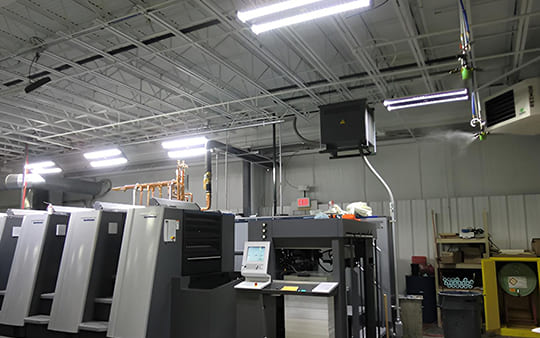
Maintaining consistent relative humidity in a DTG production environment is not as straightforward as installing a consumer humidifier and checking a gauge. The challenge is introducing moisture evenly, without wetting surfaces, equipment, or garments in process. Conventional humidification approaches that produce larger water droplets carry real risk in a production setting: wet garments, moisture on printheads, and inconsistent conditions across different areas of the floor.
Dry fog humidification works differently. The AKIMist®E produces a fog with droplet sizes in the range of approximately 7.5 micrometers in volume median diameter. Droplets at this scale evaporate before they contact surfaces, which means humidity can be raised and stabilized in the production environment without introducing liquid water to equipment or materials. For a process as sensitive as DTG, where the margin between acceptable and unacceptable output can be narrow, that distinction matters.
The goal is not to hit a specific number and declare the problem solved. It is to remove ambient humidity as a moving variable so that when quality issues arise, the list of contributing factors is shorter and more manageable.
DTG printing rewards consistency. The chemistry works best when conditions are stable, and the process is most predictable when the environment around it is not adding variability that operators cannot see or control. Pretreatment, ink, garment handling, and press settings all get close attention in a well-run operation. The air in the room deserves the same.