Dry Fog Air Conditioning to Boost Output by 30% and Improve Quality in Textile Factories


Solutions or Products Featured
in This Case Study
Manufacturing nonwoven materials requires a high level of process stability. From fiber carding to quality inspection, environmental conditions can directly influence fiber behavior, static generation, and final product consistency.
For manufacturers producing materials used in hygiene products such as wet wipes, diapers, and sanitary pads, even small fluctuations in humidity can lead to disruptions in production and variations in product quality.
This was the situation faced by Industrias Maquinsa, a nonwoven fabric manufacturer based in Puebla, Mexico.
Industrias Maquinsa specializes in manufacturing nonwoven fabrics used across the hygiene products industry. Their production lines depend on stable fiber behavior and precise material control.
However, before implementing a humidity control solution, their team encountered several issues related to low ambient humidity.
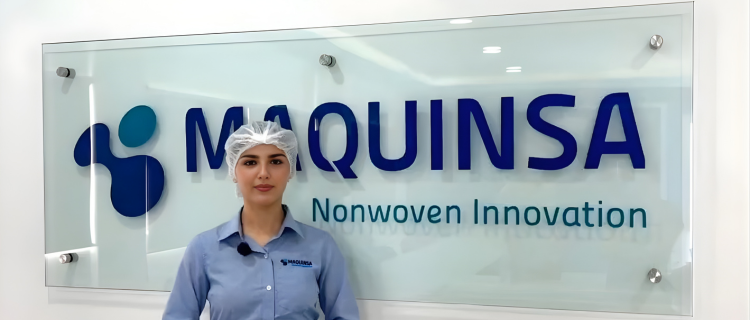
According to Ana Encinas from Industrias Maquinsa:
“Before installing a humidity control system, we were dealing with diverse problems in our production process. Static building, variations in the material quality, and efficiency reduction in the production lines.”
Low humidity is a common challenge in nonwoven production environments. As relative humidity drops, static electricity becomes more prevalent. Fibers become harder to control, web formation becomes less stable, and material handling becomes more unpredictable.
In Maquinsa’s case, the instability caused by dry conditions was directly affecting production performance.
“The low ambient humidity was affecting the stability of our processes. It became a priority to find a solution that would allow us a more controlled and reliable environment.”
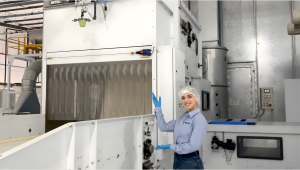
Maquinsa first encountered Ikeuchi’s humidification technology at an international supplier trade show in the United States.
After learning more about the technology, the company conducted trials inside their facility to determine whether it could address their environmental control challenges.
“After researching more about the technology and conducting trials in our factory, we confirmed that this was the appropriate solution for our needs.”
Following successful testing, Maquinsa decided to implement the AKIMist® dry fog humidification system in two areas where humidity control had the greatest operational impact.
One advantage of the system was its ease of installation. The Maquinsa team handled the setup internally, integrating the equipment into their production environment without major modifications.
“The installation was handled by our own team. It was simple and integrated perfectly in our work space without any need of major modifications.”
This type of flexibility is particularly valuable in active manufacturing facilities where minimizing downtime and avoiding large infrastructure changes are key considerations.
Since implementing humidity control with AKIMist, Maquinsa reports clear improvements across several areas of their production process.
“Since keeping the humidity controlled with AKIMist, we’ve observed big improvements.”
Key benefits observed include:
Maintaining appropriate humidity levels helps suppress electrostatic buildup, improving fiber control during processing.
Stable environmental conditions lead to more uniform material properties and fewer variations between batches.
Production lines run more smoothly when environmental factors remain consistent.
“The product’s quality is more uniform and consistent, the work environment is more stable and easy to control.”
Nonwoven production processes such as carding, air-laying, and web handling are particularly sensitive to environmental conditions. Fibers used in hygiene materials are lightweight and easily influenced by static charges.
When humidity drops too low:
Maintaining optimal relative humidity helps neutralize static electricity and stabilize fiber behavior throughout the production process.
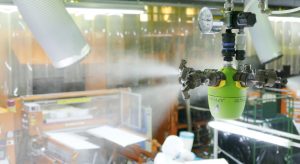
Dry fog humidification offers a particularly effective solution because it introduces extremely fine water droplets that evaporate rapidly in the air without wetting equipment or materials. This allows manufacturers to maintain precise humidity levels without risking moisture contamination.
For Industrias Maquinsa, implementing dry fog humidification has helped create a more controlled and reliable manufacturing environment.
“For us, AKIMist has proven to be a reliable, practical and effective solution to keep the correct humidity and protect the integrity of our production process.”
As demand for high-quality hygiene materials continues to grow globally, maintaining stable production conditions becomes increasingly important. Humidity control is one of the simplest ways manufacturers can improve both operational efficiency and product consistency.