Controlled Humidity = Health Benefits | Measures for Employee Wellbeing | Improve Work Environment



Across industries, facilities, and applications, many of the questions we hear are surprisingly consistent.
Whether a production environment involves manufacturing, processing, printing, or controlled storage, teams often face similar challenges when it comes to maintaining stable conditions. Over time, certain questions come up again and again, usually when processes become inconsistent or seasonal changes begin to affect performance.
Rather than treating these as isolated concerns, these questions offer insight into how environmental control is commonly misunderstood and why stability matters more than many realize.
This is one of the most common questions we hear.
Relative humidity is often treated as a single number to achieve. If a sensor reads the target value, it is assumed that the environment is under control. In reality, that reading represents only one point in space at one moment in time.
What matters just as much as the setpoint is how stable and uniform humidity is throughout the environment. Fluctuations over the course of a day, localized dry areas, or rapid swings when systems cycle on and off can all affect materials and processes, even when the average reading appears acceptable.
In controlled environments, consistency over time and across the space is often more important than reaching a specific number.
Another frequent assumption is that HVAC systems are designed to manage humidity as part of normal operation.
In most facilities, HVAC systems are primarily engineered for temperature control and human comfort. While they may remove or add some moisture as a byproduct of heating and cooling, they are not typically designed to maintain tight humidity tolerances required for process stability.
In fact, heating systems often dry the air, while cooling systems can create uneven moisture distribution. Without dedicated humidity control, environmental conditions can fluctuate significantly even when temperature remains stable.
This question often comes up when issues are intermittent or difficult to trace.
Humidity influences how materials behave, how static electricity forms, and how consistently processes repeat. When humidity is too low, too high, or unstable, these effects may not cause immediate failure, but they introduce variability.
That variability can show up as quality drift, increased waste, or the need for frequent adjustments. Over time, these small inefficiencies add up, even if the role of humidity is not immediately obvious.
Seasonal changes are one of the clearest indicators that the environment is playing a role.
Outdoor air conditions vary significantly throughout the year, and indoor environments often follow suit unless actively controlled. Dry winter air and humid summer air can each create their own challenges, especially in facilities that rely on HVAC systems alone.
When issues appear or worsen during specific seasons, it is often a sign that environmental conditions are drifting outside the range where processes perform best.
Concerns about moisture exposure are common, particularly in production environments where water can cause damage or contamination.
Not all humidification systems behave the same way. Traditional methods that introduce larger droplets can increase the risk of wetting surfaces if not carefully managed.
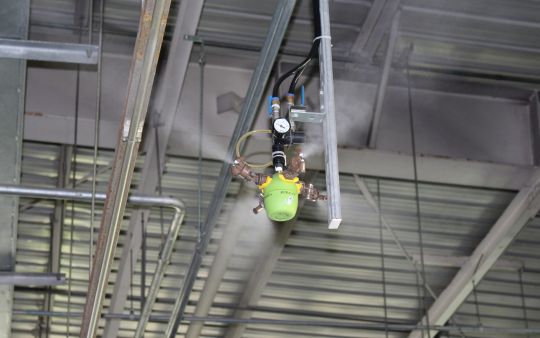
Dry fog humidification addresses this concern by producing ultra-fine mist particles that evaporate quickly in the air. This allows humidity to be increased and maintained without wetting equipment, materials, or floors, making it suitable for environments where moisture exposure is a concern.
This may be the most important question of all.
Environmental issues often present as inconsistency rather than outright failure. When problems appear intermittently, change throughout the day, or persist despite equipment checks and process adjustments, the environment is worth evaluating.
Humidity control is not about assuming it is always the answer. It is about recognizing when environmental stability may be contributing to ongoing challenges.
At their core, these questions reflect a common theme: environmental control is often treated as secondary, even though it directly affects process stability.
Humidity is not just a background condition. It is a variable that interacts with materials, equipment, and workflows every day. When it is stable, processes tend to run more predictably. When it fluctuates, variability increases.
Effective humidity control is less about reacting to problems and more about preventing them. By maintaining stable, uniform conditions, facilities can reduce the need for constant adjustments and improve overall consistency.
Dry fog humidification supports this approach by providing precise, even humidity control without introducing excess moisture. Rather than acting as a corrective measure, it helps create an environment where processes can perform as intended.
Across industries, the same questions keep coming up for a reason. They point to the importance of treating the environment as part of the system, not just the space around it.