Optimal Humidity Levels For Each Industry | Diverse Industries, One Solution | Maximum Efficiency with Dry Fog


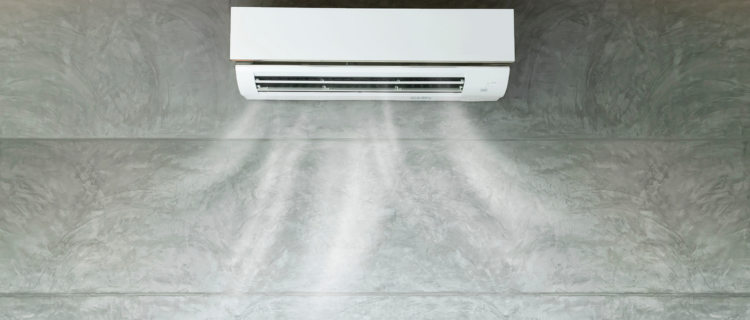
Most facilities rely on HVAC systems to control temperature. But while heating and cooling are handled with precision, humidity is often unintentionally altered as a byproduct of the process.
Understanding what actually happens to moisture inside a basic HVAC system helps explain why independent, room-level humidification is often necessary.
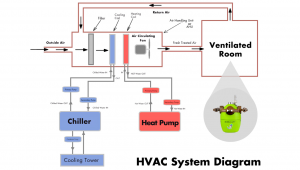
When outside air enters the Air Handling Unit, it passes through the cooling coil supplied by a chiller.
As warm air contacts the cold coil surface, its temperature drops. When air cools below its dew point, moisture condenses into liquid water. This condensate is drained away.
In simple terms:
This is intentional dehumidification. It protects comfort and prevents condensation issues downstream. However, it also means that by the time “fresh treated air” reaches the ventilated room, its absolute humidity may already be significantly reduced.
In many facilities, especially in colder climates or tightly controlled production environments, the result is air that is too dry for optimal process stability.
The heating coil in an HVAC system works differently, but the effect on humidity can be just as dramatic.
When air is heated:
Because relative humidity is temperature dependent, heating air without adding moisture causes relative humidity to drop.
This is why winter air often feels dry indoors. The HVAC system warms the air, but unless moisture is added back, relative humidity can fall to levels that promote static buildup, material distortion, and process inconsistency.
Unlike cooling, heating does not remove water. It simply dilutes existing moisture by increasing the air’s capacity.
Traditionally, humidifiers are installed inside the Air Handling Unit. The idea is simple: condition the air once, then distribute it throughout the building.
However, this centralized approach has limitations:
In production environments such as printing, electronics manufacturing, and indoor agriculture, precision at the point of process matters more than average building humidity.
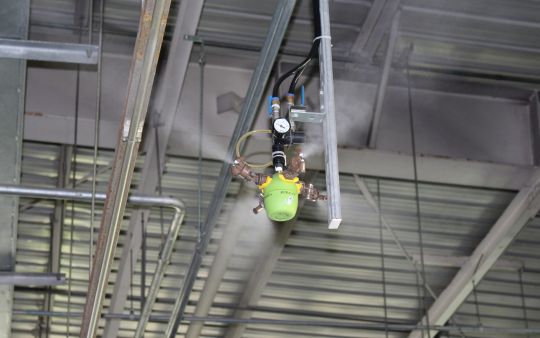
AKIMist®E is typically installed directly inside the ventilated room rather than inside the HVAC unit.
This changes the control strategy.
Instead of trying to predict what humidity will be after it travels through ductwork, the system:
Because Dry Fog droplets are ultrafine and evaporate in mid-air without wetting surfaces, humidity can be increased safely and uniformly within the occupied or production space.
The HVAC system continues doing what it does best: temperature control and air circulation. AKIMist®E compensates for the unavoidable moisture loss created by those processes.
HVAC systems are designed primarily for temperature management. Dehumidification during cooling and relative humidity reduction during heating are natural outcomes of that design.
AKIMist®E is not a replacement for HVAC. It works alongside it.
By installing humidification directly in the ventilated room:
In environments where static, material behavior, or biological growth depend on precise humidity control, this distinction becomes critical.
Temperature alone does not define environmental stability. Moisture must be managed with equal precision.