Absolute and Relative Humidity: The Relationship with Static Charge


When a product becomes the standard in its category, imitation tends to follow. AKIMist®E has been the recognized name in dry fog humidification for decades, and over the years we have seen a number of foggers appear on the market that share its silhouette, its color cues, and its general shape. From across a facility floor, some of them look strikingly similar.
The shape is the easy part to copy. The performance is not.
This article is not about calling out individual products. It is about helping facility managers, plant engineers, and procurement teams understand what dry fog actually requires from a piece of equipment, so that the difference between a genuine unit and a lookalike becomes visible in the place it matters most: how the fogger performs over months and years of operation.
Before comparing units, it helps to be precise about the term. Dry fog refers to a mist composed of droplets small enough that they do not wet surfaces on contact. In practical terms, that means an average droplet size below roughly 10 microns, measured as a Sauter mean diameter. At that size, droplets evaporate into the air before they reach a surface, raising humidity without leaving moisture behind on product, packaging, or equipment.
A fogger that produces droplets in the 15 to 30 micron range is not making dry fog. It is making fine mist. The visual difference is small. The operational difference is significant. Fine mist settles. Dry fog does not.
Most lookalike foggers fall into the fine mist category, even when they are marketed using the term dry fog. The reason has less to do with intent and more to do with what it takes to consistently atomize water to a sub-10 micron range.
Atomization at this scale depends almost entirely on the nozzle tip. Specifically, it depends on the geometry of the orifice where compressed air and water meet, the tolerances held during manufacturing, and the material the tip is made from.
This is where it helps to understand who Ikeuchi is. We are not, at our core, a humidifier company. We are nozzle designers and fog engineers. For over 70 years, our work has centered on the physics of how liquid breaks into droplets, how those droplets behave in air, and how to control both with precision. AKIMist®E is one expression of that expertise, built on a catalog of thousands of nozzle designs developed for industries ranging from steel to semiconductor. The fogger is the package. The nozzle is the product.
AKIMist®E uses a precision-engineered plastic tip. The choice of plastic is deliberate. The orifice geometry must remain stable through years of continuous contact with water and compressed air, and the right plastic resists wear and corrosion in a way that brass does not.
Many imitation foggers use brass tips. Brass machines easily and looks substantial, but it wears at the orifice and corrodes in the presence of water and trace impurities. Once the orifice geometry begins to drift, even by a few microns, droplet size drifts with it. The spray pattern degrades quietly. The fogger still runs. The humidity readings still climb. But the droplets are larger than they were on day one, and the surfaces below the fogger start showing it.
This is why a spec sheet number from a brand new imitation unit does not tell you what that unit will do six months in.
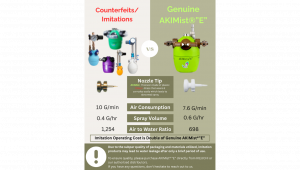
Looking at side-by-side measurements between AKIMist®E and a representative imitation, the numbers reveal something counterintuitive.
The genuine unit consumes approximately 7.6 grams per minute of compressed air. A typical imitation consumes around 10 grams per minute. The genuine unit produces roughly 0.6 grams per hour of fog. The imitation produces approximately 0.4 grams per hour.
In other words, the imitation uses more air to produce less fog.
That relationship is captured in the air-to-water ratio. AKIMist®E operates at a ratio of roughly 698. The imitation operates at approximately 1,254. A higher ratio is not a sign of efficiency. It is a sign that the fogger is working harder to do less, which translates directly to operating cost. In real terms, the cost of running an imitation is roughly double the cost of running the genuine unit for the same amount of fog produced.
Compressed air is one of the most expensive utilities in any facility. A fogger that wastes it does so every minute it runs.
Air consumption is the visible cost. There are others that take longer to surface.
Imitation foggers often use lower-grade packings, seals, and internal materials. Within a relatively short operating window, water leakage from the body of the unit is common. Leaks mean dripping onto product, accumulation on floors, and the kind of moisture variability that defeats the purpose of installing a fogger in the first place.
Output also tends to drift. As internal components wear, fog volume per unit decreases, and facility teams compensate by adding units or running longer cycles. The original equipment cost looked attractive on the purchase order. The total cost of ownership tells a different story.
These are the issues that bring us calls from facilities that bought a lookalike fogger, ran it for a season, and are now trying to understand why their humidity control no longer behaves the way the brochure described.
If you are evaluating a dry fog humidifier, the most reliable way to know what you are getting is to purchase AKIMist®E directly from Ikeuchi or through one of our authorized distributors. The unit you receive will match the specifications it was designed to meet, the materials will be the ones we engineered around, and the performance you measure on day one will be the performance you can plan around for years.
We are always available to answer questions about specifications, installation, or whether a unit you already own is a genuine AKIMist®E. If you are unsure, send us a photo. We are happy to take a look.