Enhance Winter Printing Efficiency with Dry Fog Humidifier AKIMist



Print rooms have a rhythm. The steady hum of the press, the scent of ink, the precise movement of paper through rollers. When everything is balanced, the results are sharp and vibrant. Behind that consistency is an invisible factor that can affect every print job: humidity.
Paper is hygroscopic, meaning it absorbs or releases moisture depending on the surrounding air. When relative humidity falls too low, paper contracts and static electricity can build up. Sheets may stick together, misfeed, or shift slightly during printing. When humidity is too high, paper absorbs excess moisture, which can lead to curling, wrinkling, or paper jams.
Even small swings of 5 percent in relative humidity can alter paper dimensions and affect registration, color accuracy, and finishing processes. Maintaining stable humidity levels is therefore critical for consistent quality.
IKEUCHI’s AKIMist® “E” Dry Fog Humidifier produces ultra-fine water droplets, averaging 7.5 microns in diameter. These droplets are smaller than a human hair and evaporate instantly, turning into water vapor before reaching surfaces. This ensures that the environment is evenly humidified without wetting paper, floors, or sensitive printing equipment.
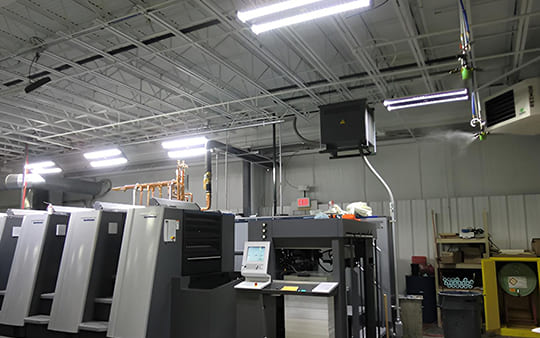
Dry Fog can be distributed across wide spaces, maintaining consistent conditions throughout press rooms, finishing areas, and storage zones. Uniform humidity reduces microclimate variations that can cause inconsistencies in print quality.
Dry Fog Humidification supports multiple printing applications:
In all these applications, maintaining the recommended relative humidity levels (typically 50 to 55 percent for paper) protects materials and improves workflow efficiency.
Implementing a Dry Fog system involves assessing the size of the print space, airflow patterns, and paper handling zones. Nozzles are positioned to optimize air mixing and ensure even humidity distribution. The system can be integrated with existing environmental control systems to monitor and maintain target humidity levels.
In modern printing, success depends on repeatability and control. From commercial printing and packaging to high-end publications, stable environmental conditions are necessary to meet color standards, reduce waste, and maintain tight production schedules.
By converting humidity into a controllable variable, Dry Fog Humidification enables print facilities to protect materials, optimize equipment performance, and maintain consistent output year-round.