Enhance Winter Printing Efficiency with Dry Fog Humidifier AKIMist


When print quality or process stability starts to slip, the first instinct is usually to look at the press.
Is something out of alignment?
Are rollers worn?
Is the feeder acting up again?
In many cases, that instinct is correct. Mechanical issues do happen. But in print environments, there is another variable that often goes overlooked because it is less visible and harder to diagnose: humidity stability.
Printing relies on controlled interaction between substrates, ink, and equipment. When the surrounding environment fluctuates, even well-maintained machines can struggle to deliver consistent results. Below are three common printing issues that are frequently attributed to equipment performance, when humidity is often a contributing factor.
Registration issues are commonly treated as a calibration or tension problem. When misalignment appears intermittently, operators may spend hours adjusting settings, recalibrating sensors, or compensating at the press.
What is often happening instead is dimensional change in the substrate.
Paper, board, and many films are hygroscopic materials. They absorb and release moisture depending on ambient humidity. Even small changes in relative humidity can cause substrates to expand or contract, especially in facilities where conditions fluctuate between shifts or throughout the day.
This can lead to:
When humidity is unstable, the substrate itself becomes a moving target. The press may be performing exactly as designed, but the material it is handling is not behaving consistently.
The result is time lost chasing mechanical solutions to what is fundamentally a material response to environmental change.
Sheet feeding problems are among the most frustrating issues on the production floor. Double-feeds, misfeeds, sheets clinging together, and erratic stacking are often blamed on worn components, feeder settings, or operator technique.
While those factors certainly matter, static electricity plays a significant role in how substrates move through printing and finishing equipment.
Static buildup increases as humidity drops or fluctuates. Dry conditions allow static charges to persist, causing sheets to attract or repel each other unpredictably. This is especially common during colder months or in tightly climate-controlled facilities where air is heated and dehumidified.
Common symptoms include:
In many cases, operators compensate by slowing the press, adjusting feed parameters, or accepting higher waste. These are understandable responses, but they do not address the underlying cause.
Maintaining stable humidity reduces static generation and allows substrates to move through equipment more predictably, improving handling without constant mechanical intervention.
When print quality changes gradually over the course of a shift, it is often attributed to ink behavior, roller condition, or operator variability. These factors do influence results, but environmental conditions can quietly affect all of them at once.
Humidity impacts:
If humidity rises or falls throughout the day, ink may behave differently on the same material using the same press settings. Operators may compensate with incremental adjustments, but consistency becomes difficult to maintain when the environment itself is changing.
This is particularly noticeable in facilities where HVAC systems cycle aggressively or where outdoor conditions influence indoor air quality.
When print quality appears unpredictable despite stable press settings, the environment is often a contributing variable worth evaluating.
One of the most persistent misconceptions about humidification is that it is simply about adding moisture to the air. In printing environments, the real goal is stability.
Stable humidity allows:
Without stability, even high-performance print equipment is forced to operate in changing conditions. The result is increased setup time, more adjustments, higher waste, and inconsistent quality.
Environmental issues are difficult to diagnose because they do not fail dramatically. They drift. They change gradually. They often look like operator error or equipment inconsistency rather than a clear system fault.
Humidity also tends to be measured at a single point, rather than evaluated for uniformity and consistency throughout the space. A single reading does not reflect how conditions vary across a production floor or over time.
As a result, humidity problems can persist for years, quietly eroding efficiency and quality without ever being formally addressed.
Addressing these challenges requires more than simply raising humidity levels. In print environments, the objective is to maintain a stable, uniform condition that supports consistent material behavior without introducing new risks.
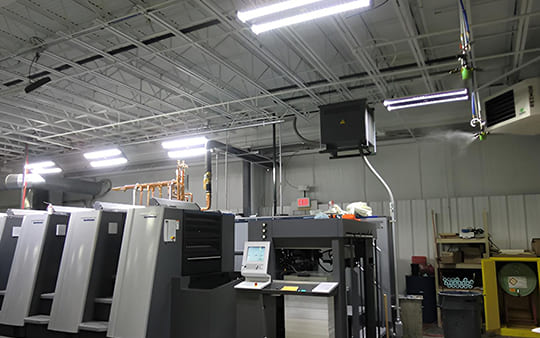
Dry fog humidification is designed specifically for this purpose. By producing ultra-fine mist particles that evaporate quickly in the air, dry fog systems increase and maintain relative humidity without wetting substrates, equipment, or floors. This allows humidity to be controlled precisely, even in production spaces where moisture exposure would otherwise be a concern.
Because dry fog disperses evenly throughout the space, it helps minimize localized fluctuations that can lead to dimensional changes in substrates, static buildup, and variability in ink behavior. When humidity remains stable across the production floor and over time, print equipment can operate within its intended environmental range, reducing the need for constant adjustments and reactive troubleshooting.
Rather than acting as a corrective measure, dry fog humidification functions as a preventive control. It supports the equipment, materials, and operators already in place by creating an environment where consistency is achievable day after day.
Print equipment is designed to perform within specific environmental ranges. When those conditions are met consistently, presses, feeders, and finishing equipment can operate as intended.
Rather than viewing humidity control as an add-on or secondary system, many facilities are beginning to treat it as part of their process infrastructure. The goal is not to replace equipment solutions, but to support them by creating an environment where they can perform reliably.
When mechanical issues arise, it is still important to inspect the press. But when problems appear intermittently, seasonally, or without a clear mechanical cause, the environment deserves a closer look.
Sometimes, the equipment is not the problem at all.