3 Common Print Problems You Might Be Blaming on Your Equipment

Modern inkjet production print operations run on automation. Color management software corrects for drift before an operator would ever notice it. RIP software queues jobs, nests layouts, and adjusts for substrate variance in real time. Press electronics monitor head temperature, ink viscosity, and nozzle firing patterns continuously. Yet in most shops, the humidity in the room where all of that precision equipment lives is left to whatever the HVAC system happens to be doing that day, and in the colder months, that is rarely enough.
As outdoor air gets colder, the air pulled into a building and heated for comfort loses much of its capacity to hold moisture. Relative humidity on the production floor can drop well below what most substrates and inks were designed to run in, and unlike a color shift or a clogged nozzle, a humidity swing does not throw an error code. It just shows up as a slow accumulation of defects that get blamed on everything except the actual cause.
Digital inkjet presses, whether running label stock, packaging board, or commercial sheet and roll substrates, depend on the media behaving predictably from the first impression to the last. Paper and paperboard are hygroscopic. They absorb and release moisture based on the surrounding air, and in a dry environment they lose moisture, contract, and often curl at the edges. That dimensional movement is a problem for any press relying on precise registration, since a substrate that shrinks between the first and fourth color station will not register the same way it did in a humidity-controlled test run.
Dry air also increases the risk of static buildup on sheet-fed and roll-fed equipment alike. Static causes sheets to cling together during feeding, leading to double feeds, misfeeds, and jams that stop a job mid-run. On the output side, static can attract dust to a freshly printed sheet before it is fully cured, leaving contamination that shows up as a defect only after the job is already stacked or packed.
Ink behavior shifts too. Aqueous and UV inkjet formulations are calibrated to interact with substrate coatings in a specific way, and substrate moisture content affects how quickly and evenly ink is absorbed. In low humidity, faster and more uneven absorption can show up as inconsistent color density or mottling, problems that often get chased through color profiles and ink settings when the root cause is sitting in the ambient air.
Here is the part that should catch a plant manager’s attention: most of these failure points are already being managed indirectly, and expensively, by everything else in the shop. Color management software recalibrates to compensate for substrate variation it cannot actually fix. Operators requeue jobs and rerun spoiled sheets. Maintenance teams troubleshoot feed jams that trace back to static, not mechanics. All of that is automated compensation for a variable that was never automated in the first place.
Humidity control on most press floors is still handled the way it was decades ago, by a facility HVAC setpoint that was never designed with print substrates in mind, adjusted manually if someone happens to notice a problem. A shop that has invested in automating every other variable in its production process is leaving one of the most influential variables to guesswork.
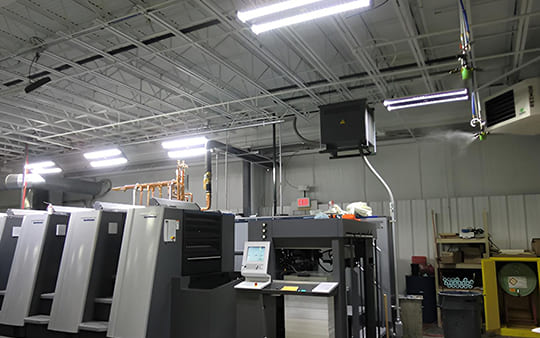
This is where Dry Fog humidification earns its place alongside the rest of an automated production floor. AKIMist®E generates a Dry Fog with a Sauter mean droplet diameter of 7.5µm, fine enough to evaporate into the air rather than wetting substrates, equipment, or product on the line. Because the system uses sensor feedback to maintain a target relative humidity, it functions the same way the rest of a modern print operation does: it responds to real conditions automatically rather than waiting for a person to notice a problem.
For substrate stability, that means paper and board hold their dimensions more consistently from the first sheet to the last. For static, adding moisture to the air raises its conductivity, which is the established mechanism by which humidification reduces static buildup and the feeding and dust-attraction issues that come with it. And because AKIMist®E is a Dry Fog system, it adds humidity to the air without introducing the surface moisture that could interfere with ink adhesion or curing on press.
It is worth being precise about what this solves. AKIMist®E adds humidity to bring dry air up to a target level; it is not a dehumidification system, and shops dealing with excess moisture would need a different approach entirely. For the dry-air problem that shows up every year as the weather turns colder, though, it closes a gap that the rest of an automated press room has been quietly working around.
Print operations have gotten remarkably good at automating precision. The next logical step is treating the air on the production floor with the same discipline as the press itself. If winter humidity swings are showing up as feed jams, registration drift, or color inconsistency on your floor, our team at Ikeuchi USA is glad to talk through what a Dry Fog system could look like for your operation. Reach out anytime to start that conversation.