What Your Coffee, Your Guitar, and Your Cleanroom Have in Common



In wood products manufacturing, the press line is where everything comes together. Boards are layered, adhesive is applied, and pressure holds it all in place while the bond forms. The machinery is well understood. The materials are carefully specified. The schedule is built around throughput.
What is less often controlled with the same precision is the air in the room where all of this happens.
For operations that rely on moisture-cure adhesives, humidity is not a comfort consideration — it is part of the chemistry itself. When the air is dry enough, the bond does not form properly. And in much of North America, the air is dry enough to cause problems on a regular basis.
Wood is hygroscopic. Even after kiln drying, it continuously exchanges moisture with the surrounding air. When relative humidity (RH) rises, wood absorbs moisture and expands. When RH drops, wood releases moisture and contracts. This is true of raw lumber, engineered cores, veneer wear layers, and finished panels alike.
In a manufacturing setting, this creates two compounding risks:
Both are directly influenced by the ambient RH of the facility. Industry guidelines for wood products manufacturing typically target 40% to 60% RH throughout production, storage, and staging areas. Operating below that range introduces risk at multiple points in the process.
Polyurethane-based adhesives — commonly called PUR adhesives — are the standard choice across engineered hardwood flooring, architectural panels, laminated beams, mouldings, and wood composite products. They are specified for their bond strength, elasticity, and durability in service.
What makes them effective also makes them environmentally sensitive.
PUR adhesives are one-component, moisture-cure systems. The curing reaction is not triggered by heat or a separate catalyst. It is triggered by moisture — drawn from both the wood surface and the ambient air in the press environment.
Under adequate humidity, the reaction proceeds on schedule:
When RH drops significantly below recommended levels, the reaction slows. Less ambient moisture means slower green strength development, which means longer press times to reach safe release strength — and fewer press cycles per shift as a result.
If parts are released before the bond is stable, the result is delamination: a failure that may not appear until the product is already in the field.
The impact of low humidity on a press line is rarely a dramatic single event. It is a gradual tightening of the operational window that creates pressure throughout the facility.
When cure rates slow, press operators face a straightforward tradeoff:
For facilities running continuous operations, even modest extensions to the cure window compound quickly. Over a year in a dry climate, the lost capacity is significant. And delamination discovered after shipment carries costs that go well beyond the value of the individual product: warranty claims, field replacements, and damage to customer relationships that take years to build.
Once humidity is identified as a production variable, the instinct may be to add moisture aggressively. In wood manufacturing, that creates a different set of problems:
The goal is not maximum moisture. It is stable, controlled moisture — an ambient RH that supports curing chemistry without introducing free water anywhere in the process.
This is where humidification system engineering matters.
Conventional humidifiers — steam-based, ultrasonic, or high-pressure misting — produce droplets large enough to fall under gravity and wet whatever they contact. In a wood products environment, that means veneer, panels, glue lines, and equipment.
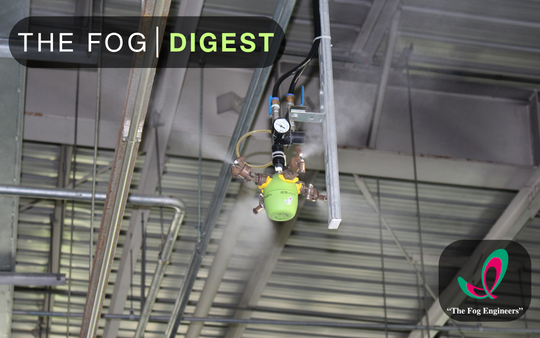
The AKIMist®E Dry Fog Humidifier produces droplets of 7.5 microns or less. At that size, droplets do not fall. They remain suspended in the air, behave more like a gas than a liquid, and evaporate before reaching any surface. RH rises because the air is carrying more water vapor — not because any surface has been wetted.
For a wood products facility, this distinction is fundamental. The AKIMist®E raises and maintains ambient RH in press areas, staging zones, and storage areas to the levels required for consistent PUR curing — without any risk of direct moisture contact with materials or equipment.
The system also runs at low energy consumption, without the heat load of steam humidification or the maintenance demands of high-pressure pump systems. Units can be positioned to address specific zones, allowing different areas of the facility to be managed independently.
The problems caused by low humidity in wood products manufacturing rarely announce themselves clearly:
The cost accumulates quietly. Reduced throughput, extended press times, field failures traced to bond quality — these are predictable outcomes of an uncontrolled variable. They are also preventable ones.
The AKIMist®E Dry Fog Humidifier offers a practical path to that consistency — one that works with the chemistry of the process rather than around it.