Different Humidification & Installation Methods | Types of Humidification | Premium Dry Fog



Most people intuitively understand what mist is, but dry fog can sound contradictory. How can something be fog without wetting surfaces? The answer comes from physics.
Dry Fog behaves differently because of the physical characteristics of the droplets themselves. In this article, we explain the science behind evaporation, droplet size, and airflow while using the established definition of Dry Fog as droplets 10 microns or smaller, which naturally remain suspended and evaporate quickly in air.
Imagine two droplets: one the size of a grain of sand, and one the size of smoke. Both are water, yet they behave very differently.
The key difference is the relationship between surface area and volume.
• Small droplets have a much larger surface area relative to their size.
• More surface area allows water to evaporate more quickly.
• Faster evaporation means a droplet is less likely to reach a surface before turning into vapor.
Dry Fog droplets fall below 10 microns, which places them in a size range where they stay suspended and evaporate efficiently. This comes from geometry and physics, not from any additive or unusual process.
Evaporation always moves from liquid water into the air until the surrounding air approaches saturation.
The rate depends on the difference between the vapor pressure at the droplet surface and the vapor pressure of the surrounding air. When the air is dry, evaporation accelerates. When humidity is high, evaporation slows.
Smaller droplets evaporate faster for two simple reasons:
These principles apply universally to any water droplets. Dry Fog systems operate within the droplet size range that naturally supports rapid evaporation.
A droplet does not fall simply because it is water. It falls when gravity outweighs the air resistance acting against it.
Physics provides a clear relationship.
• Large droplets have enough mass to fall rapidly.
• Very small droplets experience strong air resistance compared to their mass.
Around 10 microns and below, droplets behave more like particles in smoke or haze.
• They remain suspended.
• They move with air currents.
• They avoid forming liquid on surfaces because they evaporate before landing.
This behavior aligns with the recognized definition of Dry Fog.
Because Dry Fog droplets stay suspended, airflow plays a stronger role than gravity in determining where they move.
This supports uniform distribution:
This is similar to how smoke or fine particles naturally fill a room.
Condensation forms when air is saturated and encounters a cooler surface.
Dry Fog droplets help avoid this outcome because:
This is a natural result of droplet size and evaporation rate.
Any humidification method can create condensation if humidity is pushed above recommended ranges. Within typical targets, small droplets behave consistently and predictably.
Mist and Dry Fog are often compared, but droplet size places them in different regimes of behavior.
Property |
Misting |
Dry Fog |
Droplet Size |
Tens to hundreds of micrometers | Under 10 micrometers |
Behavior |
Falls quickly | Stays suspended |
Surface Wetting |
Common | Minimal under correct operating conditions |
Evaporation |
Slower | Faster |
Dry Fog is a classification based on physics and droplet behavior, not simply a different type of mist.
The physics of small droplets helps explain why Dry Fog is useful in environments where precise humidity control is necessary.
These outcomes arise from the physical properties of droplets in this size range.
Dry Fog may seem counterintuitive at first, but its behavior becomes clear once you look at the physics of droplet size, evaporation, and airflow.
Small droplets do not behave like large droplets. They follow different patterns of movement, suspension, and evaporation.
By working below the 10 micron threshold, Dry Fog naturally evaporates quickly, stays suspended, and avoids surface wetting. These behaviors match what physics predicts for droplets of this size.
Understanding these fundamentals makes Dry Fog much easier to visualize and appreciate.
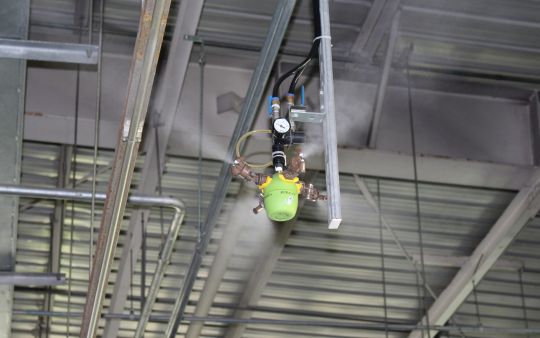
The AKIMist® E produces Dry Fog at a sauter mean droplet size of approximately 7.5 microns, which places it well within the Dry Fog classification of 10 microns or smaller. This droplet size supports fast evaporation and suspension in air, which is central to Dry Fog behavior. The following features contribute to its recognition as an industry standard for fine fog humidification: